As it turns 30, Hasitha Fernando looks at the story behind the 1996 blockbuster Independence Day…
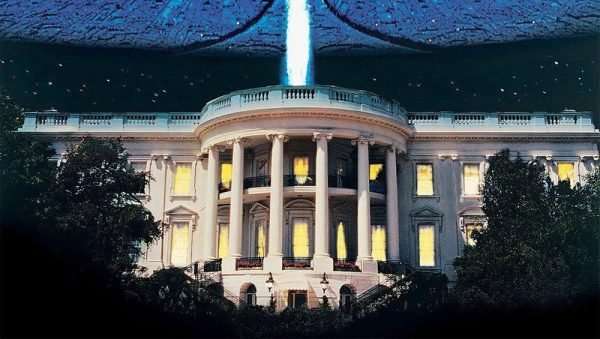
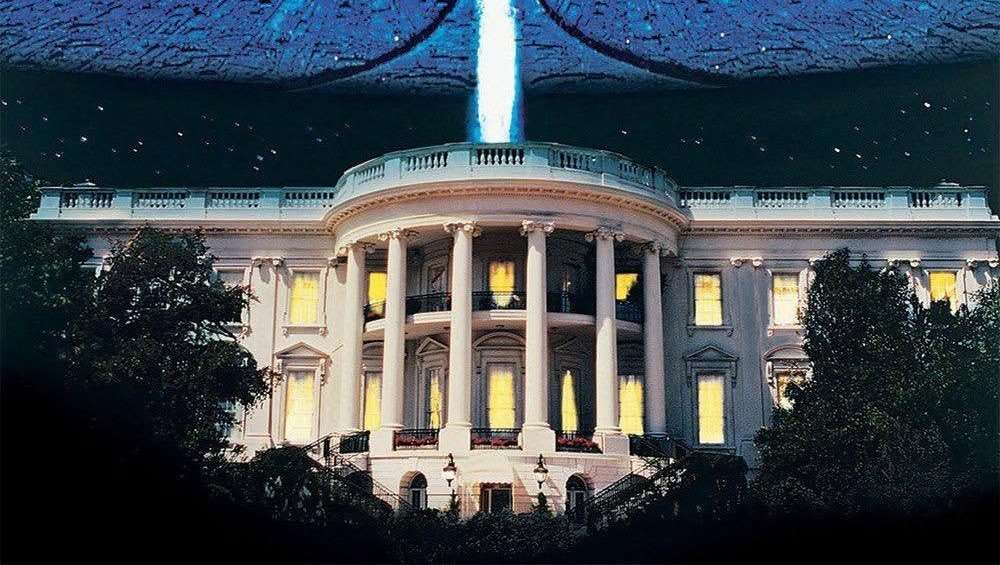
One of the most unforgettable moments in the history of blockbuster filmmaking has got to be a colossal plasma beam completely laying waste to the White House in Independence Day. I mean, who can forget it right? Today, as the blockbuster celebrates its 30th anniversary we look back at its behind-the-scenes story and the making of the box-office juggernaut that was Independence Day…
The filmmakers got the idea for the story while promoting Stargate
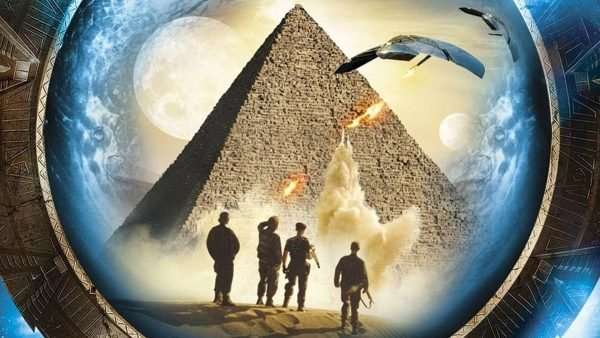
The filmmaking duo of Roland Emmerich and Dean Devlin were the talents behind some of the most massive sci-fi film hits in the 1990s. The start of this lucrative collaboration started with the success of 1994’s Stargate. Whilst on promotional tour of that film Emmerich and Devlin were doing a Q & A session with a group of reporters when one of them asked Emmerich why he made a movie featuring aliens if he didn’t believe in their existence. Emmerich responded that in spite of his belief he was fascinated by them and elaborated the response given by asking the reporter to imagine what it would be like to wake up one morning to find massive fifteen-mile-wide spaceships hovering over the largest cities in the world. It was at that moment that Emmerich realized he had the idea for their next project. And that was pretty much how the bare bones concept of what would be Independence Day happened. Devlin was always of the opinion that an alien invasion should be something “grand scale” because he simply hated the low-key manner in which alien invasions took place in movies prior. The duo hastily penned the script during a month-long vacation in Mexico and sent over their output to multiple studios. That was a Thursday, the project was green-lit by 20th Century Fox chairman Peter Chernin and went into pre-production on Monday.
Will Smith was always the top choice to play Captain Steven Hiller
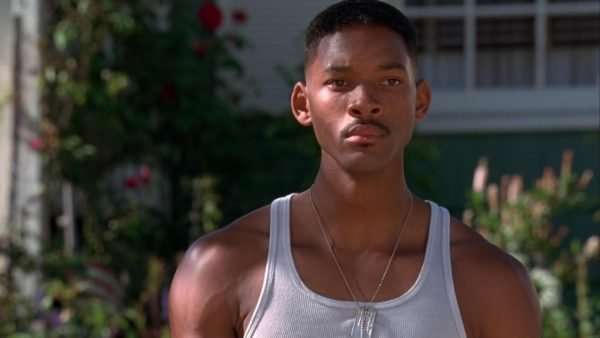
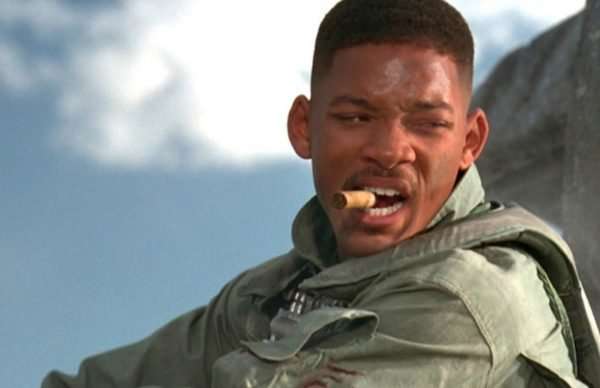
Both Devlin and Emmerich always envisioned an African-American actor playing the role of Captain Steven Hiller and specifically wanted the up-and-comer Will Smith to play the fearless U.S Marine Corp pilot, after seeing his engrossing performance in 1993’s Six Degrees of Separation. Up to that point, Smith was mostly known for his comedy-centric hit TV show The Fresh Prince of Bel-Air, so convincing the studio execs proved to be a challenging affair, with some even critiquing the hire from a racial standpoint. But Emmerich stood his ground saying Smith was ‘the’ man for that part. Suffice to say, the role launched the young actor into superstardom making him one of the most sought-after names in showbiz. Prior to Smith’s hiring Ethan Hawke was considered for the role but the actor turned down the offer since he wasn’t a fan of the script he read.
Most of the dialogue Jeff Goldblum shared with other actors were improvised
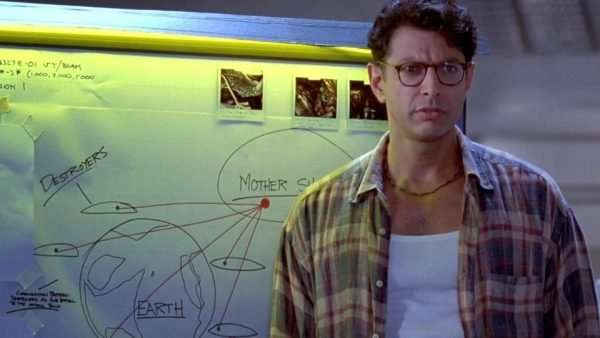
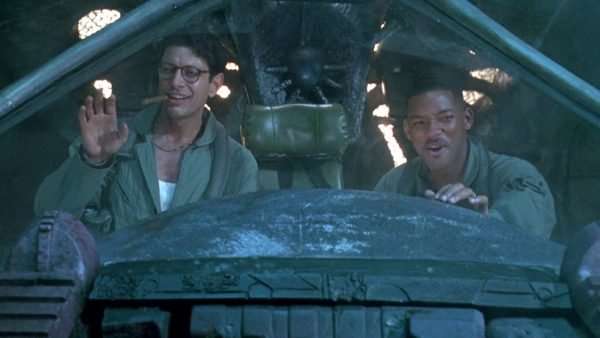
In a career that spans over five decades Jeff Goldblum started off with smaller roles in films like Nashville and Annie Hall, before gaining a wider recognition with the likes of Invasion of the Body Snatchers, The Big Chill and The Fly. Goldblum then shifted to the world of blockbuster franchise films with Jurassic Park and Independence Day in the 1990s and became a frequent collaborator with Wes Anderson on movies such as The Grand Budapest Hotel and Isle of Dogs later on. Goldblum was given free rein to adlib most of the dialogue he had with other actors in the movie and the guy certainly delivered. Quite surprisingly, the first choice Emmerich and Devlin had in mind to play the quirky IT engineer was Matthew Broderick, who certainly would have brought a whole different vibe to the character. Broderick went on to play the lead role in the pair’s next effort – Godzilla.
Kevin Spacey was the first choice to play President Thomas J. Whitmore
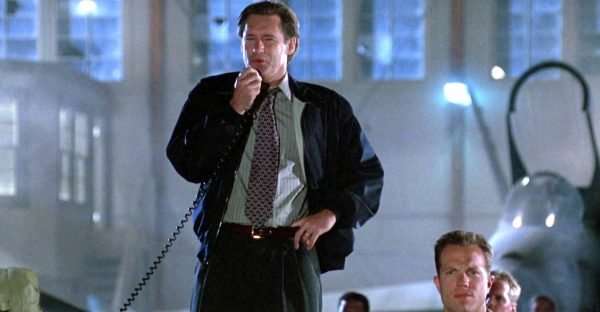
Making his big screen debut with Ruthless People in 1986, Bill Pullman became one of the most sought-after talents in the 1990s with movies like Sleepless in Seattle, Wyatt Earp, Casper, Lost Highway and Lake Placid. The part of President Thomas J. Whitmore was originally written for Kevin Spacey, who was a childhood friend of Devlin. The character was supposedly intended to be more like a Richard Nixon-esque figure but once Pullman was cast in the role it was re-written to suit his personality. As preparation for the role Pullman read Bob Woodward’s The Commanders and watched the documentary film regarding Bill Clinton’s campaign called The War Room.
The U.S military pulled out after the producers refused to remove the Area 51 references
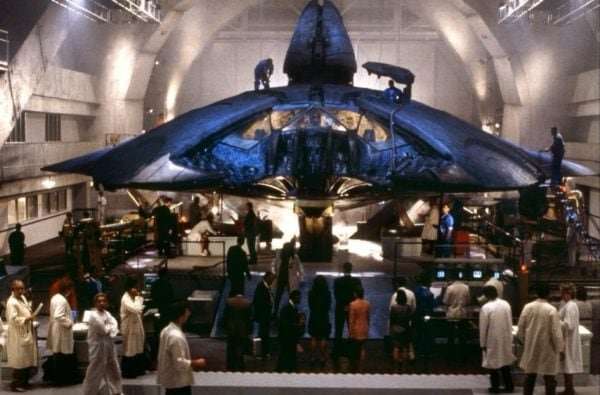
When production for the film commenced the U.S military agreed to support the movie by allowing the crew to film at their military bases, offering consultations for the actors who were playing military roles and providing costumes and vehicles needed the production. But all this support stopped once they learned about the extensive role Area 51 played during the latter half of the movie and when the filmmakers refused to make alterations to the script and accommodate them, the U.S military withdrew their support for the film.
Two character designs were combined to create the terrifying alien creature
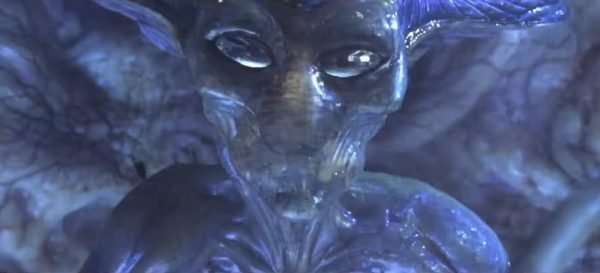
Over the years Patrick Tatopoulos has lent his creative talents to some of the biggest Hollywood blockbusters. From doing creature designs in movies like Stargate, Godzilla, I, Robot and the Underworld franchise, to engaging in production design work in films such as Dark City, Live Free or Die Hard, Batman v. Superman: Dawn of Justice and Justice League. When it came to Independence Day, Tatopoulos came up with two gnarly character designs for the aliens. The actual alien found inside the biomechanical suit was designed by Tatopoulos to be “both familiar and completely original” to the grey alien mythos, while the terrifying 8 feet tall, multi appendage biomechanical suit was something totally new. Unsure on which creature design to settle on, Emmerich decided to amalgamate both concepts into one and thus, the concept of the bio-mechanical suit was birthed.
The movie holds the record for most miniatures to be featured in a single film
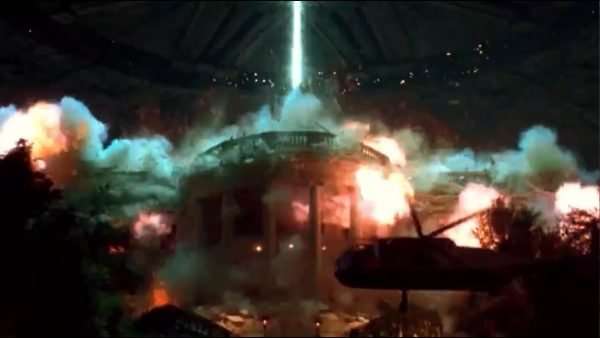
To bring to life the large-scale destruction of the alien invasion, a cunning mix of CGI and practical effects wizardry were utilized in the film. Miniature models were used so extensively in Independence Day that to this day the flick holds the world record for the greatest number of miniature model work to appear during a production. Michael Joyce, the model shop supervisor, who worked on Independence Day estimated that more miniatures were used for the film than in any other two films combined and due to the dramatic shift to CGI use many in the industry say that this record may remain unchanged, as miniature use have become a lost art of sorts. One of the most awe-inspiring scenes that transpire during Independence Day is the complete obliteration of the White House by a massive plasma ray. This too was accomplished through the use of miniatures, where a 1/12 scale of the actual monument that was exploded. A total of nine cameras filmed this explosion at various speeds and played back at normal speed to make the radiation blast appear larger and slower on film. This scene was used prominently in the film’s trailers and TV spots for promotional purposes and is widely regarded as the most iconic shot in the movie.
David Arnold had a hard time composing the score for Independence Day
English film composer David Arnold got his break by crafting the stunning score for Stargate. Afterwards, Arnold played an instrumental role in recontextualizing the soundscape of the James Bond franchise starting with the high-octane Tomorrow Never Dies. Arnold continued contributing to the globe trotting super spy’s adventures for over a decade whilst also lending his talents to other genre efforts such as Shaft, Zoolander, 2 Fast 2 Furious and Hot Fuzz. Arnold isolated himself in a Los Angeles hotel room for almost four months, in order to avoid the hype for the film whilst composing the score for it. During an interview the musician revealed that he recorded the score with an orchestra of 90 accompanied by a choir of 46 along with “every last ounce of stereotypical Americana he could muster for the occasion”. Arnold’s hard work paid off, as the musician went on to win the Grammy Award for Best Instrumental Composition written for a motion picture or television the following year.
There were legal issues to secure the name “Independence Day”
That’s right. An unexpected legal issue arose because Warner Bros. owned the rights to the title Independence Day. Therefore, as a temporary measure, until 20th Century Fox resolved the problem, the abbreviation “ID4” was used and other alternative titles such as “Invasion”, “Sky on Fire” and “The End of the World” were considered prior to Fox and Warner Bros. reached a deal. The right to use the desired title was eventually won a few weeks later.
Major Box-Office success, positive reviews, award wins and beyond
Produced on a budget of $75 million Independence Day went on to make a massive $817.4 million at the worldwide box-office going on to become the highest grossing film of the year 1996, surpassing both Mission: Impossible and Twister. The movie received positive reviews at the time of its release and as of writing maintains an impressive 77% on review aggregator site Rotten Tomatoes with an average rating of 7.1/10. The site’s critical consensus sums up the effort in the following manner, “Harkening back to the spirit of classic sci-fi and souping it up with modern pyrotechnic bravura, Independence Day is a proudly goofy invasion epic whose lack of pretension earns it an enthusiastic salute.” Mick LaSalle of The San Francisco Chronicle called it the “apotheosis” of comic book space adventure movies while Entertainment Weekly’s Lisa Schwarzbaum gave the film a B+ for living up to its massive hype and further added that, “charm is the foremost of this epic’s contemporary characteristics. The script is witty, knowing, cool.” The movie also had its share of luck during awards season with it snagging the Academy Award for Best Visual Effects and winning the Grammy Award for Best Instrumental Composition written for a motion picture or television.
Independence Day along with Twister marked a significant turning point for the Hollywood blockbuster with a string of VFX driven disaster films, like Dante’s Peak, Volcano, Deep Impact and Armageddon, being produced in the wake of the aforementioned movies resounding success. The IP’s success led to the storyline and its mythos expanded though tie-in books and video games for fans. A sequel to the original was in the works since 2011, however, Will Smith’s massive paycheck demand certainly made the studio think twice on green lighting back-to-back sequels, as Emmerich and Devlin had originally planned. After multiple delays the duo were willing to go ahead without Smith’s involvement, as a result the sequel, Independence Day: Resurgence, was produced without the actor reprising the very role that made him a household name. The sequel proved to be a critical and financial disappointment, scuttling Emmerich and Devlin’s plans for a potential threequel but the future of the franchise still remains uncertain following the purchase of Fox by The Walt Disney Company.
What are your thoughts onIndependence Day? Let us know on our socials@FlickeringMyth…
Hasitha Fernando is a part-time medical practitioner and full-time cinephile. Follow him on Twitter via @DoctorCinephile for regular updates on the world of entertainment.