This article was first published in Radio Times magazine in June 1980

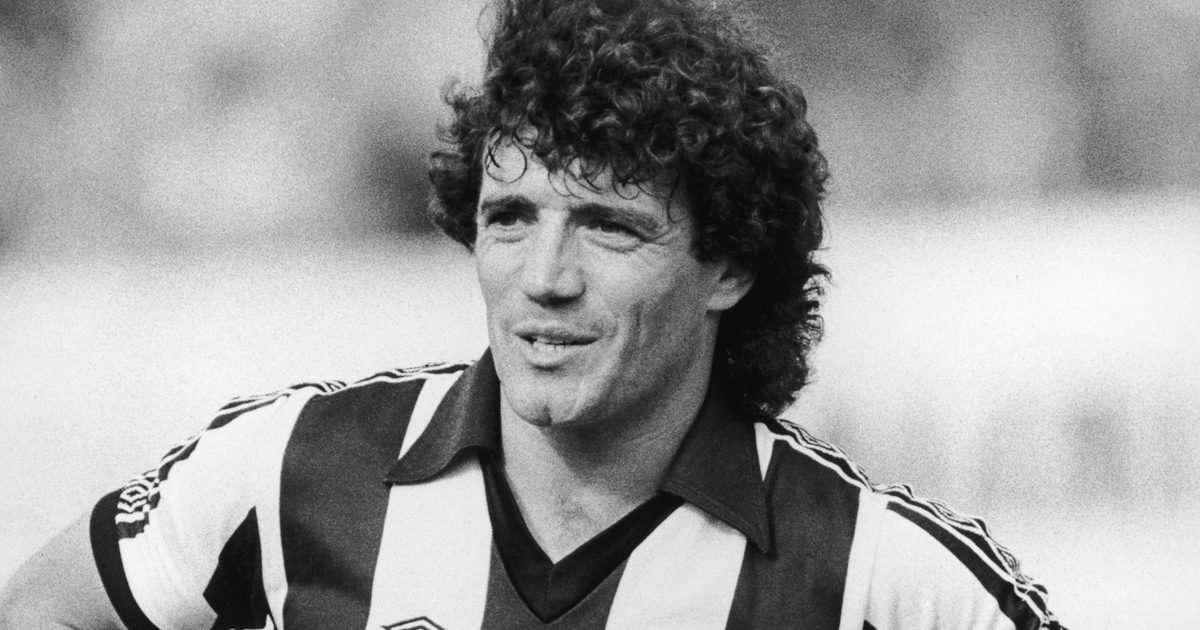
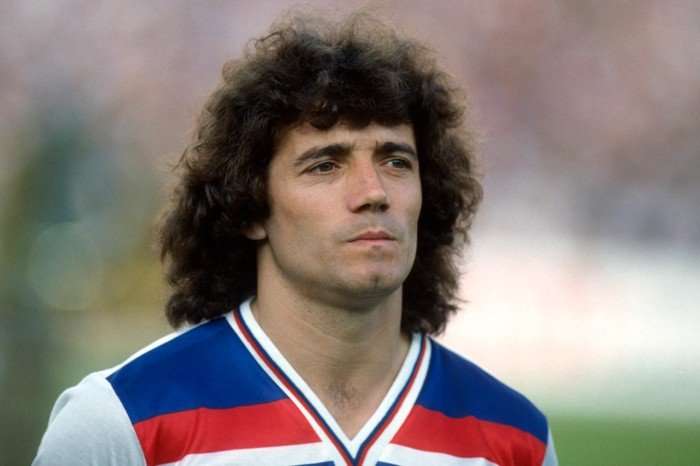
Kevin Keegan, twice European Footballer of the Year, is England’s captain as they bid to win the European Championship. His qualities as a player and a man are at the heart – many would say, are the inspiration – of England’s football revival. Ian Wooldridge went to Hamburg – to the home Keegan is leaving when he returns to play for Southampton next season – to interview the player who believes that leading his country is the greatest honour of his life.
The political philosophies of the dynamic young chairman of KK Enterprises Ltd sounded as though they had been vetted and thoroughly approved by Mrs Thatcher as the framework for some forthcoming Tory manifesto.
Uncompromisingly reliant on such solid values as the work ethic and unblemished family life, they advocated hard work in return for hard work, immediate relief for those contemplating exile because of punitive taxation, and a sharp jab in the ribs for those shoddy British industries which flood foreign markets with machines that bust the moment you turn the switch on.
Also there was scathing condemnation of the British athletes stubbornly bound for Moscow and, from the heartfelt recollections of countless business trips behind the Iron Curtain, the standard party-line riposte for those who do not instantly denounce all things Communist.
“What I always tell them,” said the young chairman on the sun terrace of his £160,000 house, with the two Mercedes in the drive and the 600 trees in the grounds and the two Old English sheepdogs lolloping about on the immaculately-mown lawns, “is that if they’re that keen they should go and live there. It’s quite true that Communists have all got the same. They’ve all got nothing.”
That said, it would be as well to advise the Conservative Central Office that there is no future in chatting up KK Enterprises Ltd in the hope of a sizeable donation to Party funds. “I have never,” announced its founder and chief shareholder, “voted anything but Labour in my life. And I never will.”
Over lunch, amid the velvet drapes and cut crystal of the Homes and Gardens dining room, he spoke movingly and at length about the long-term motivations of growing up at 25 Spring Gardens, Doncaster, a terraced house whose architectural features included a sentry-box lavatory at the bottom of the garden and a tin bath in a neighbouring outhouse.
“An environment like that breeds determination,” he said. “I’m damned glad I wasn’t brought up in a middle-class home with everything provided. If I had been I wouldn’t be where I am today.”
Where he is today is in transit between Hamburg and Southampton – and en route to his first million. “Within two years I know I shall be a millionaire,” he said, “a genuine millionaire, not a paper one.” He announced it in the matter-of-fact tones of a man revealing he has just scooped a £25 fourth-dividend on the football pools.
Talking of football, which we rarely did in six hours of conversation, the 29-year-old boss of the KK Enterprises conglomerate happens also to be the current captain of England and reigning European Footballer of the Year. Of those titles Kevin Keegan is not matter-of-fact at all. He is manifestly proud.
Keegan’s character is the best thing imposed on British football in years. It differs little under cross-examination from that which you see on the field: shrewd intelligence, darting switches of attack, a driving, head-down intensity born of the knowledge that 105 per cent effort can yield 110 per cent in dividends.
He is neither over the moon one minute nor sick as a parrot the next, for he is desperately sensitive about the impressions that footballers leave around when they use brainless pop-platitudes in TV interviews or hit the front pages with some fresh epidemic of unacceptable behaviour.
“I wouldn’t dream of criticising George Best,” he said. “In many ways he made me. But he also made mistakes. It is up to us to learn from them.”
From his pinnacle in the fierce spotlight at the top of the game he is prepared to accept the responsibility of being seen as the new exemplar of his profession.
It is quite some burden, particularly when you suspect that half the world regards you as a money-grubbing, unpatriotic arriviste, which is how Keegan was seen by some following his highly lucrative departure from Liverpool to Hamburg, his business associations with foreign firms competing against British rivals and in committing the primordial sin of just becoming very rich.
There had been a new irritation the very morning we met in his lovely house, set discreetly back from the quiet cul-de-sac in one of Hamburg’s tycoon suburbs.
Some workers made redundant by a fork-lift manufacturing firm in Coventry had read that Keegan was lending his name to endorse the reliability of a fork-lift truck manufactured in Germany. Their grievance, and an appeal to the England soccer captain instantly to sever his connections with a Kraut company unparalysed by strikes, received some prominence in the British newspapers.
Keegan’s defence, if he needed one, was to attack. “That annoys me,” he said. “I’ll tell you what my answer will be. If every single one of those Coventry workers has got an English car and not a foreign one then I’ll give them the cheque I got from the German firm. I’ll also tell them that if they’re scared of quality competition I’m sorry for them.”
Quite what an international footballer is doing in the field of fork-lift trucks may bemuse those who do not understand the wonderful world of endorsements. It is simply a fact of marketing life that if stars of the status of Keegan say a product is good the public flock to buy it. It is a process that demands much integrity, which Keegan has, but it is also mostly money for jam. The knack is in being famous and unblemished in public life. Then the endorsement contracts roll in and the cheques follow.
Keegan endorses 20 different products, including a French football boot whose sales were certainly not harmed by his elevation to Europe’s Footballer of the Year. His latest, and probably most lucrative, is with Fabergé, the male cosmetics giant whose demands on his time in any year of an initial three-year contract extend only to visiting one factory and a few sessions signing autographs.
He has also made two Fabergé TV commercials with Henry Cooper, long lost to the prize ring but still without peer in the public idolatry ratings.
Keegan adores Cooper, and the word is not too strong. He has much of Cooper’s easy, down-to-earth charm, but as he talks at length about the morality of easy money, you feel that he remains haunted by those who still live in the harsh environment of his boyhood where pennies never fell from heaven.
Keegan grew strong in a happy, united home despite the fact that his miner father took years dying of bronchitis, silicosis and, terminally, cancer. He endlessly thought up fund-raising schemes: car-washing on Doncaster race-track, window cleaning, splitting up market boxes into bundles of firewood. Most of the profits went to his mother.
At Scunthorpe, trying to make it as a footballer, he found himself an after-training job in a steel plant to earn extra money. His tone as he recalled his first encounter with the overseer still cannot conceal his contempt for what he heard. “This guy said to me, ‘Okay, the first thing we’ve got to do is find you somewhere to sleep in the afternoons.’ I was horrified.”
Conversely he speaks with pride of what his father did when the local Tory agent tried to hire the Keegan front room in Spring Gardens as an election office. “He offered Dad £35 for the day, which then was just about what he earned in two weeks. My father threw him out.”
Today Keegan employs an agent to handle his outside-football contracts. “My football earnings come direct to me,” he said. “My agent takes 20 per cent of any deal he arranges.”
It led to a mild embarrassment when his agent, who also fixes commercial contracts for the England national soccer squad, landed them a deal with Courage Breweries. Keegan, who now drinks rarely and has never smoked, refuses to endorse alcohol or tobacco. The conflict troubled him. It was ammunition for the snipers.
What the snipers did not see was Keegan responding to a request to speak to a nine-year-old boy dying in hospital of leukaemia. “I’d planned to stay about ten minutes,” said Keegan, “but I was transfixed listening to that kid talking about everything he was going to do in the future. I was there for two-and-a-half hours.” The boy died the following morning.
What they also failed to see, as I did by chance when Keegan went to train with Hamburg, was the arrival of 33 boys and five masters from a school in Gateshead. Keegan, deep crow’s-feet of end-of-season exhaustion cut in triplicate beneath both eyes, instantly reacted. He hired a room behind a restaurant and, when training was done, signed autographs and bought them Cokes. It was spontaneous and uncalculated.
The other side of stardom, cushioned though it may be by money, can be hard to handle if you have a conscience. Keegan is still stricken by the memory of leaving Liverpool with 17,000 fan letters still unanswered. “Jean and I tried to answer everything,” he said, “but to do them properly the most we could manage was 30 in a night.”
He is still upset by the autographed football, bought and posted at his own expense, which never reached a British army base in Germany. “They probably think I never bothered,” he said.
Jean is 25, pretty, practical, mother of 17-month-old Laura-Jane and Keegan’s greatest friend and strength. They met in a Doncaster fairground, which may suggest a Coronation Street romance, but was not like that at all. Jean had taken A-levels in German and was hoping to become an international secretary in Brussels.
Keegan’s academic career was crowned by two O-levels, in history and art. “The only future that seemed open to me,” he said in a line that he may just have used before, “was to become a religious painter.”
In fact it was a nun who first steered him towards his emeritus professorship in sport. Sister Mary Oliver, headmistress of the St Francis Xavier School near Doncaster, wrote in Keegan’s end-of-year report in 1961: “Kevin’s football must be encouraged.”
After an apprenticeship with Scunthorpe United came the years of idolatry with Liverpool and then, as Britain’s entry into the EEC opened up free movement of labour in Europe, there was the controversial move to Hamburg.
To a man as sensitive to criticism as Keegan, the astronomical money was earned at the cost of double anguish: in Liverpool he was rejected by many fans as a defector, in Hamburg he was cold-shouldered by German players who resented his fanfared arrival.
For several matches they refused to pass the ball to him. Even mediocre players can make a genius look foolish. In deep misery and frustration Keegan lashed out with a fist and struck an opponent who had constantly been kicking him instead of the ball.
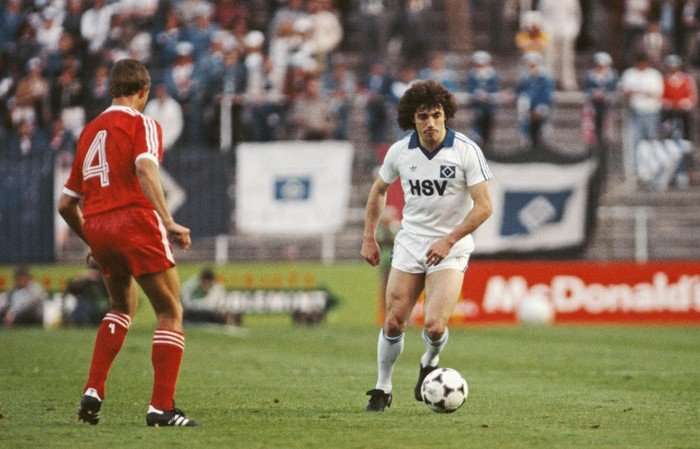
“I was walking off long before the referee could get his red card out,” recalled Keegan. “I was suspended for eight weeks. During that time Hamburg played badly. They got rid of three players and when I came back I was accepted.”
Gone, too, was the xenophobia he had felt from sections of the German crowd. “He won them over in a typical Kevin way,” said Jean. “One of the early problems was the language barrier. Fortunately my German helped. We sat at home night after night playing Twenty Questions in German.
“After about three months Kevin was asked to speak at a Supporters’ Club meeting. He could easily have done it in English with an interpreter. Instead, he got up and, to their astonishment, spoke to them in German. His grammar was simply terrible and he got plenty of words wrong, but they admired him for his tremendous effort.”
Today he speaks idiomatic German very fast. He has also started learning Spanish. “Only,” explained Keegan very quickly, “so that I shall know what’s going on at the World Cup in Spain in 1982.”
The hasty rider was to head off rumours that he is using Southampton as a springboard to one of the fabulously wealthy Spanish clubs. He lives perpetually with such rumours and has refused to speak to any German reporter for the past 18 months. “They write lies about me,” he said.
He is equally uncompromising in many of his ideas, which often sound like the terse little homilies you read on desk-calendars. Thus: “A man who does not know his worth is not worth anything.”
Keegan knows his worth precisely. The difference between him and some other footballers, he maintains, “is simply that I’m prepared to live life at 100 miles an hour. If I’ve proved anything it is that the system need never beat anyone. If I hadn’t succeeded at football I would have succeeded at something else.”
He added, surprisingly: “Technically I’m probably the worst player ever to win the title of European Footballer of the Year. I can’t do the circus tricks. I’ve had to live with my limitations. What has got me through is my work-rate. I always tell kids that they don’t need to be born footballers. If they work, work, work they can get to the top.”
Keegan’s work life is neatly divided into 50 per cent soccer, 50 per cent business, with an average of nine hours’ sleep in between. The business enterprises, he calculates, earn him twice as much as his football. They also leave him little time for leisure. When he and Jean eat out, however late, they always take their baby daughter.
He cannot comprehend people not living a similarly parcelled life, with every minute of every day set aside for positive activity. It is what disappoints him about England.
“I think we are heading towards the Latin attitude to life, mañana and all that,” he said. “I don’t want to sound critical of England because I haven’t lived there for three years now, and I love the place. Maybe it’s because the incentives have been taken away. Taxation is the killer.” Keegan voluntarily resubmits himself to the British taxation system at Southampton on 1 July.
What may seem a contradiction is, in fact, a calculated step. He knows precisely where he is going, which is into business after football. At 29, he admits, the training is getting harder every year. “At Hamburg we are trained up to the pitch of Olympic athletes and some mornings when I get out of bed I can hardly walk.”
His retirement will be sudden and for good: “I don’t plan to hang around, dropping down a division or two for the sake of staying in football.”
Between now and then Kevin Keegan will drive on, leading from the front, inspiring by example. He knows no other way to work or play. He reminds you exactly of what Britain was before bloody-mindedness set in. He could, of course, have made it to the top in any century in which he lived.