This article first appeared in Radio Times magazine.
If you want something done, they say, ask a working mum. According to the mythology, which is borne out by research into the subject, multi-tasking mothers often achieve more in a three-day work week than full-time colleagues. That the “they” in this instance are Lucille Ball and Margaret Thatcher, from whose historical quotations this modern adage derives, only serves to underline the point.
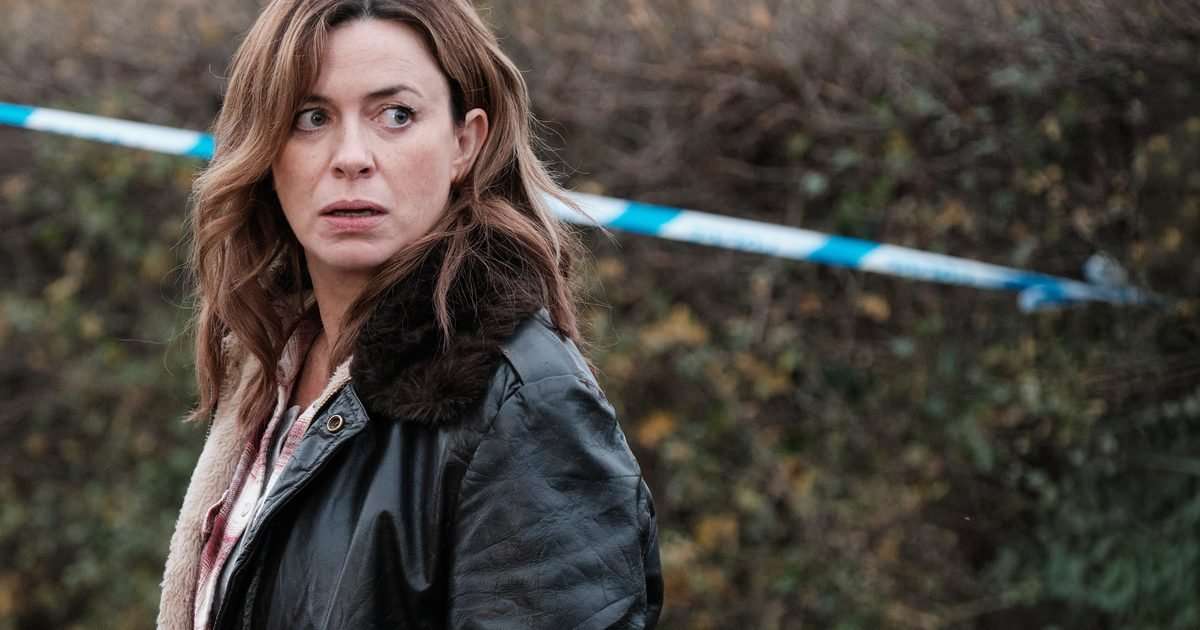
The Crow Girl’s DCI Jeanette Kilburn, played by Eve Myles, is one such woman. In series two of the intense thriller, no sooner has she got to work – admittedly after a fitful night’s sleep and a sapphic dalliance in an unfamiliar bed with a potential new partner that necessitated a walk of shame – than she is out at work, following a lead around a pig farm.
Inevitably, because The Crow Girl world is one of grim inevitabilities, brutal consequences and absurdist humour, Kilburn’s tailing of a pig pays off. Gruesome discovery is heaped upon heinous crime and back-up is required. As DC Mike Dilliston (Elliot Edusah), Kilburn’s junior partner and one of the few decent men in the drama declares, “We’re needed back at HQ,” Kilburn snaps back, striding off: “You better keep up. You better keep up. Keep up! Keep up!”
Kilburn could just as easily be talking to the audience. Milly Thomas’s adaptation of the Scandi noir trilogy by Erik Axl Sund isn’t the most straightforward of dramas, dealing with historical sexual abuse, decade-spanning legacies of violence and the coalitions of powerful men who coalesce to protect both. It is compelling, disturbing and stylised, requiring engagement and perhaps even the construction of your own spidergram, the sort you see made with red string in crime dramas. (In The Crow Girl, they use whiteboards and marker pens.)
Things are further complicated by the fact that, as series two of the drama begins on Paramount+ this week, the first series begins on Channel 5 on Monday. Paramount owns Channel 5, so this is presumably a marketing move designed to drive terrestrial viewers rapt by season one over to the streaming site to subscribe for season two.
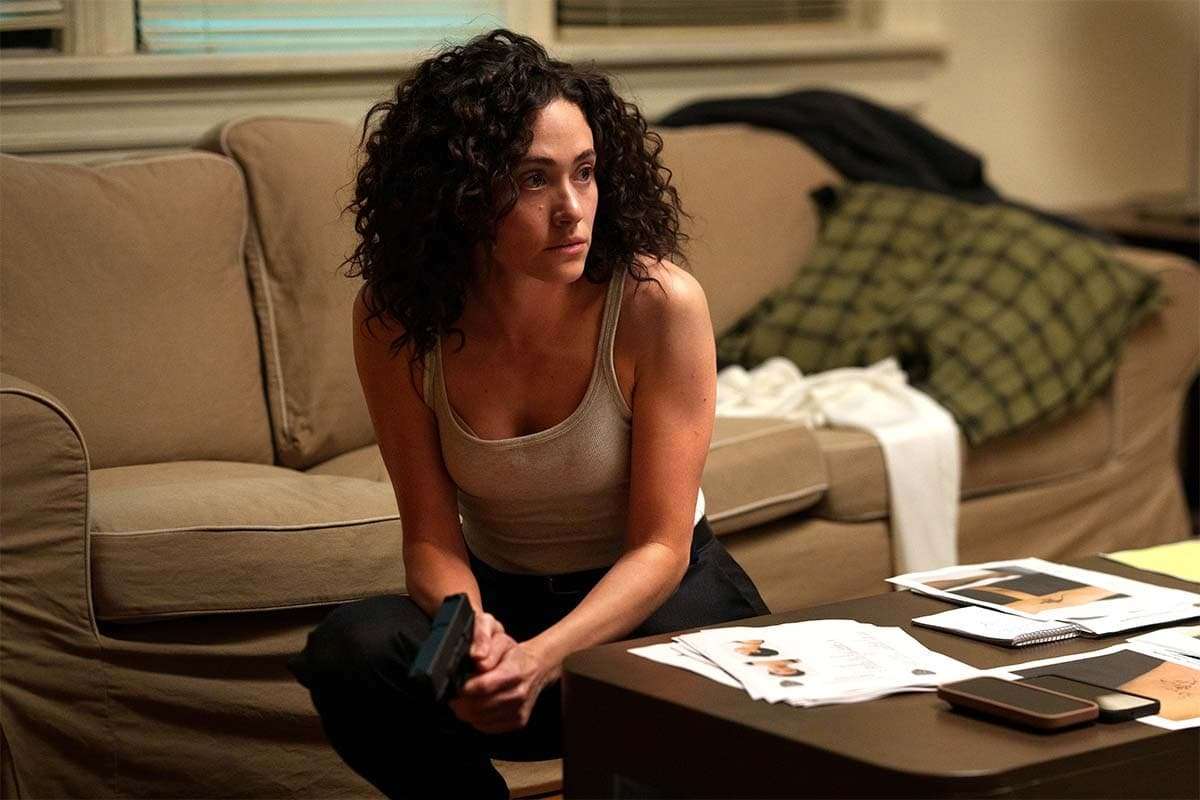
So, if you are planning to watch series one on Channel 5 stop reading now as this piece contains spoilers. As the drama returns, we find Jeanette in Sophia’s bed. We also find Mary Burkeman, mother to prime suspect Victoria, tied up in Sophia’s basement. Sophia seems untroubled at the pair’s proximity, which is the latest indicator that something might be a bit off about Sophia. Indeed, as we discovered at the end of series one – Sophia is Victoria. Jeanette is not privy to this piece of information… yet. Sophia, it seems, is a construction – or a performance.
And, while the on-screen drama picks up the morning after the events of the first season’s finale, Eve Myles explains, “We’ve basically made one 12-part series and episode one of series two feels like episode seven. It’s got that pace and propulsion, and it’s a really ballsy thing to do after a two-year break in real life.”
But it doesn’t come without its challenges, as outlined by Katherine Kelly, who plays Dr Sophia Craven. “Me and Eve changed our hair since the first series so have had to go into the wig world, which has both pros and cons,” she says. “You never have a bad hair day with a wig – you put it on, it looks amazing – but if you’re the sort of character who runs their fingers through their hair, you’re gonna have an issue. Luckily Sophia is so put together that she doesn’t really do gestures.” Sophia’s put-togetherness is critical to the show.
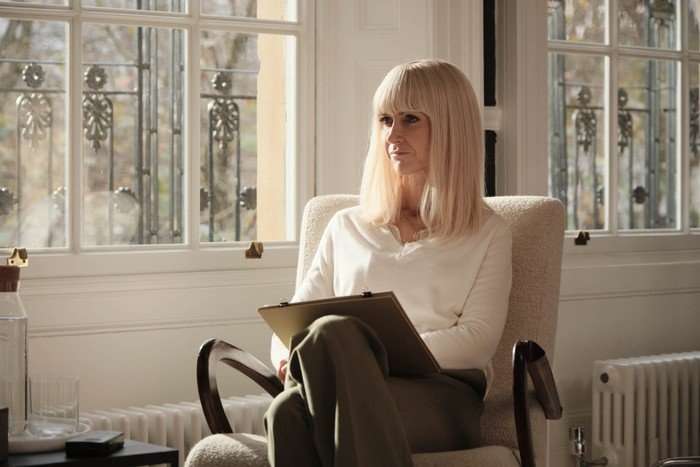
“She’s a completely different character to the one that I signed up for and I had no idea what was coming,” says Kelly. “I suppose if I’d known with hindsight, maybe I would have done things slightly differently. I’m not sure.”
Kelly normally researches backstories for her characters, from Emily Jackson in the The Long Shadow to Jo Conran, the drug- smuggling trolley-dolly of In Flight. With The Crow Girl, “I had to trust the director and writer and what I ended up doing was lots of different takes for them to choose from. It’s in the edit where this third character of Sophia-Victoria is created.”
Kelly adds that The Crow Girl is “probably the hardest job I’ve done – definitely the most complicated. It was completely out of my comfort zone.”
No aspect of the show seems comfortable or simple. As with a lot of Scandinavian crime fiction, from Wallander to The Killing, The Crow Girl is about the devastating effects of betrayal, trauma and abuse. How easy or hard was it to leave the weight of that world behind at the end of the day and at the end of the job?
Easy, Kelly says. “One of my early jobs was Tamar in Tamar’s Revenge at the Royal Shakespeare Theatre [in 2004]. She’s raped by one brother, wants the other to kill him, has this 10-minute speech in which she pleads with her dad. Then I’d come off stage and go to the pub. I remember one of the cast saying, ‘You’re really good at switching off.’ And I thought, ‘Oh yeah, I am, actually.’
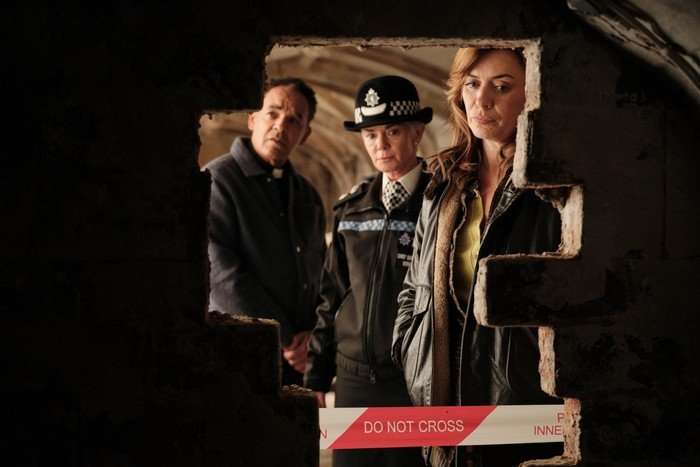
“It’s certainly not the sort of thing you want to take home to your kids, but everyday life is a very good antidote to it,” says Victoria Hamilton, who plays Chief Superintendent Verity Pound.
“I do think that part of your responsibility is to go into the darkness and the darkness is what attracts people to this kind of material. Sometimes I think, ‘Is there a relief when you watch something like this?’ You think that it’s so dark that could never be me? But I find what good people are driven to do in the wrong situation really interesting. I believe we’re all much closer to our darkness than we admit and that we spend our lives hiding a lot of ourselves from the world. It’s what we do to be liked and loved.”
For Hamilton, the popularity of stories like The Crow Girl stems from a surprising source. “The dark side of drama has been cathartic since the beginnings of theatre and because we in the West are emotionally repressed, we really need that. I think we’re all terrified at the moment and are pretending not to be. We’ve got trauma from the pandemic and it’s completely unprocessed.
“You look at the world today, with the political shifts and the climate question, and we’re actually living in a state of sort of repressed terror. I don’t know why that is. Maybe it’s too frightening to talk about. But it’s interesting that at a time when we’re all so frightened, people are drawn to watch things like ours.”
Want to see this content?
This page contains content provided by Google reCAPTCHA. We ask for your permission before anything is loaded, as Google reCAPTCHA may use cookies and other technologies. To view this content, choose ‘Accept and continue’ to allow Google reCAPTCHA and its required purposes.
Myles, who Kelly points out spends most time immersed in the horrors of The Crow Girl, has a different take. “Yes, it is a chilling and unpredictable thriller but it also shows hope and the fact that there are good people trying to bring down the bad guy. They are swimming against the tide and while some drown, others survive. They survive and they find justice. It’s a show about survivors. It’s about hope.”
Hope? “Oh, it was a relentless project and Jeanette is a whirlwind through the entire thing. To keep up that energy, I had to play the truth and not overthink it as well as finding the humanity and humour in it. I had to surrender for four months of the shoot during which time I was Jeanette more than I was Eve.”
That must have an effect? “I never took anything away with me from the first series, but with the second and delving deeper into sensitive subjects, you read things and you talk to people in those sort of situations. And it never leaves you. It is always haunting.”
And assuming that Myles doesn’t shrug it off like Kelly, or relish the dark like Hamilton, how does she deal with that? “I do a lot of running,” she says.
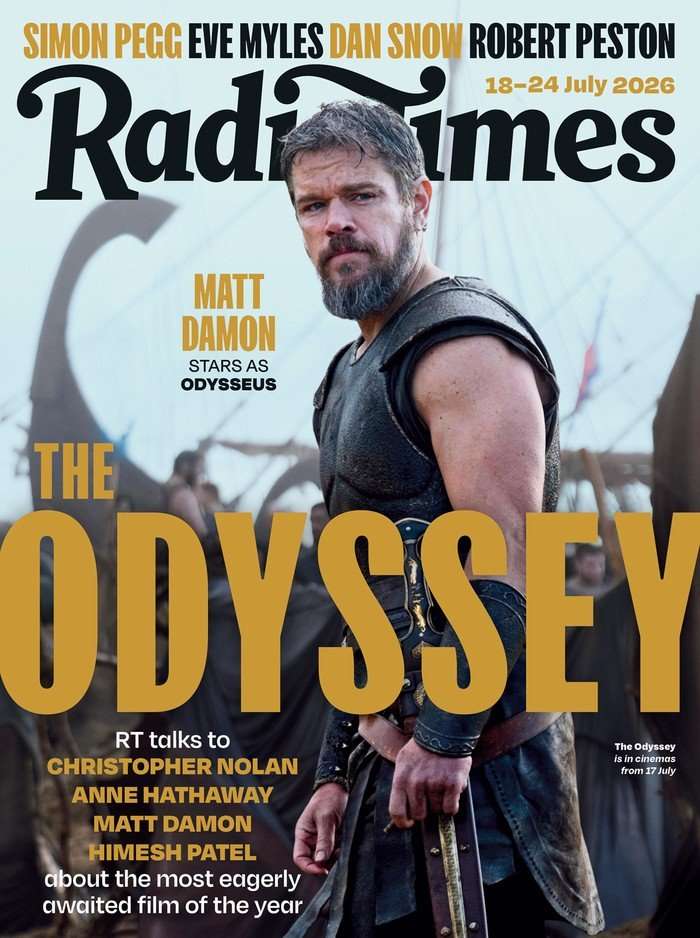
The latest issue of Radio Times is out on Tuesday – subscribe here.
Series 2 of The Crow Girl arrvies on Monday 20 July on Paramount+.
Check out more of our Drama coverage or visit our TV Guide and Streaming Guide to find out what’s on. For more TV recommendations and reviews, listen to The Radio Times Podcast.