When Sir David Attenborough first became a fixture in British living rooms, his role was not to warn us about the natural world, but to introduce us to it.
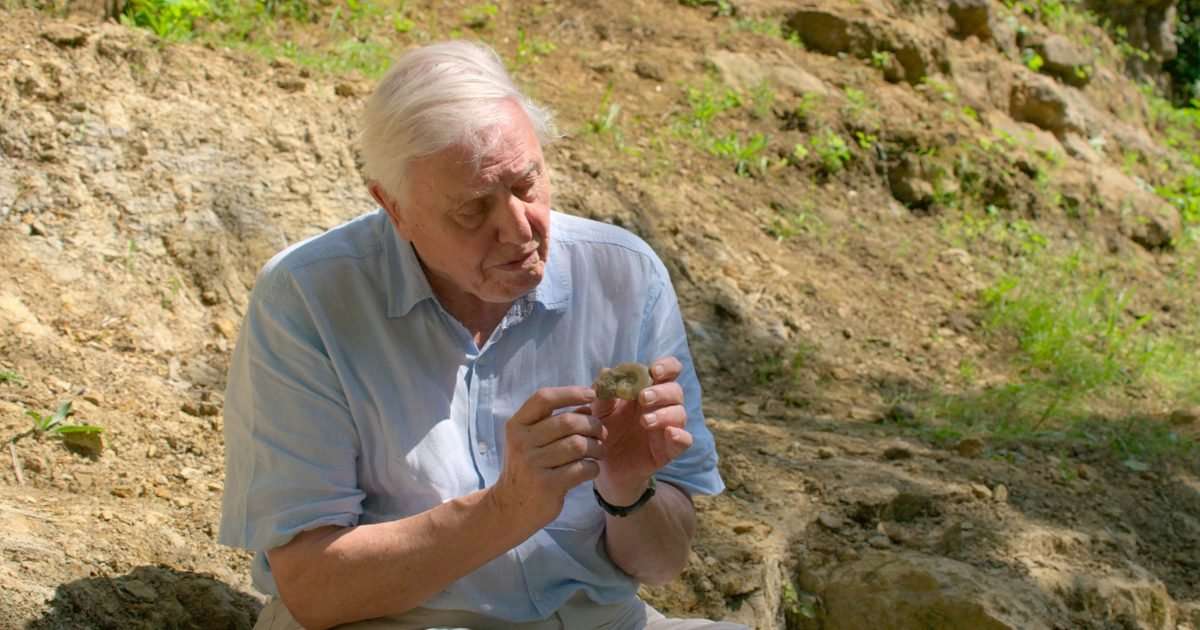
There was wonder first. Curiosity. The thrill of encounter. From Zoo Quest in the 1950s to Life on Earth in 1979, Attenborough’s great gift was to make the planet feel at once vast and intimate: a place of remote forests, deep oceans, frozen plains and extraordinary creatures, but also one that could be brought, through the strange new magic of television, into the home.
For decades, the Attenborough tone was defined by awe. He did not need to raise his voice. The authority was in the hush: the careful pause before a creature emerged, the whispered observation, the sense that he was not conquering a landscape but waiting respectfully within it. He was a guide, not an orator; a witness to marvels that, for many viewers, might otherwise have remained unimaginable.
But as Attenborough reaches his 100th birthday on Friday 8 May 2026, the arc of his broadcasting life has become more than a history of natural history on screen. It is also a record of changing environmental consciousness. Across seven decades, the voice that once invited us simply to look has increasingly urged us to act.
The early Attenborough programmes were products of their time. They were driven by discovery, collecting, classification and spectacle: the language of post-war exploration translated for television.
By the time of The Blue Planet in 2001 and Planet Earth in 2006, the scale had changed. Advances in filming technology made the natural world look more cinematic than ever, but they also made its fragility harder to ignore. The camera could travel further, dive deeper and stay closer for longer. It could reveal beauty, but also damage.
Blue Planet II in 2017 marked one of the clearest turning points. Ostensibly a return to the oceans, it became a cultural moment around marine plastic pollution. The images of albatrosses feeding plastic to their chicks, and of waste reaching even the most remote waters, helped bring the issue into everyday conversation. Reuters described the series as having “jolted public opinion”, with government and major retailers subsequently announcing measures to reduce plastic use.
It was a reminder of something unusual about Attenborough’s place in British life: he could still command a mass audience, but he could also move it. His programmes did not simply document concern; they helped create it.
The voice becomes a warning
What changed most strikingly in Attenborough’s later years was not his subject, but his emphasis. The wonder remained, but it was now shadowed by consequence.
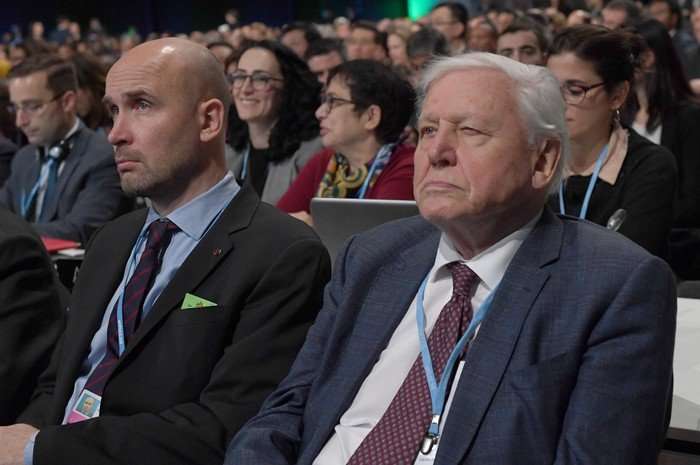
In 2018, addressing world leaders at COP24 in Katowice, Poland, Attenborough – speaking from the “People’s Seat” – warned: “Right now, we are facing a man-made disaster of global scale. Our greatest threat in thousands of years. Climate Change.” He added that, without action, “the collapse of our civilisations and the extinction of much of the natural world is on the horizon.”
It was not the language of a detached narrator. It was the language of an advocate.
Read more:
- David Attenborough – 7 covers from a seven-decade career
- David Attenborough’s 10 best series from Planet Earth to Dynasties
That shift became impossible to miss in Climate Change – The Facts in 2019, Extinction: The Facts in 2020 and David Attenborough: A Life on Our Planet later the same year. These were not simply wildlife films with a cautionary ending. They were direct interventions: programmes built around scientific warning, human responsibility and the possibility – still, just – of repair.
Netflix described A Life on Our Planet as the story of a broadcaster reflecting on the loss of wild places while offering a vision for what could still be done, the film explicitly framed as Attenborough’s “witness statement” for the natural world and his “vision for the future”.
That phrase – “witness statement” – matters. This was testimony. Attenborough was no longer only telling us what camera crews had found in jungles, oceans and deserts. He was telling us what he had seen change during his own lifetime.
The biographical force of that argument is hard to overstate. Born in 1926, Attenborough has lived through a century in which human beings have transformed the planet at extraordinary speed. His longevity gives his warning an unusual moral weight: this is not a young activist imagining a possible future, but a broadcaster comparing the present with a living memory of abundance.
An activist, but still Attenborough
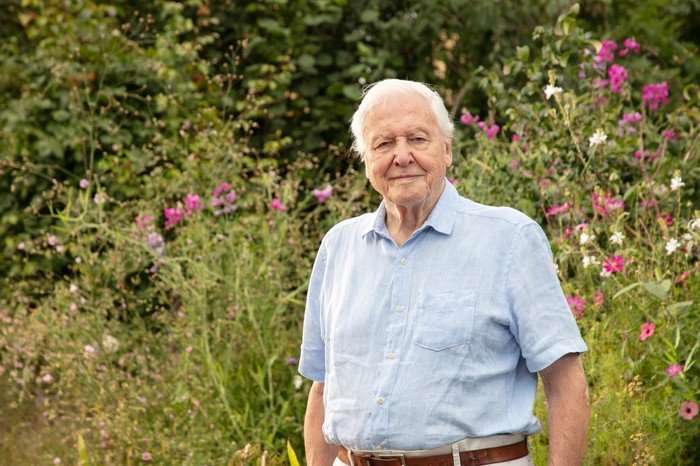
For all that, Attenborough’s evolution into a climate advocate has not made him sound like someone else. His authority still rests on restraint.
He does not typically speak in slogans. His later programmes still begin with beauty because that has always been his method: show people what exists, then show them what is being lost. The call to action lands because it follows the evidence of the eye.
That may be why his environmental turn has been so powerful. Audiences who might resist being told what to think have spent decades trusting Attenborough to show them what is there. When that same voice says time is running out, the warning feels less like a campaign line than a conclusion reluctantly reached.
He has also resisted simple despair. Even his starkest films tend to end with the possibility of recovery. A Life on Our Planet argues not merely that humans have damaged the planet, but that restoring biodiversity is the route back to stability. Our Planet, released by Netflix in 2019 and narrated by Attenborough, similarly combined spectacle with an explicit focus on how climate change affects living creatures.
There is a tension here that has defined late Attenborough: the voice of wonder has become the voice of alarm, but not of hopelessness. His message has hardened, but it has not curdled. Nature, in his telling, is wounded but not passive; given space, it can recover. The tragedy is that humans have caused the crisis. The hope is that humans can choose differently.
The burden of being believed
In an age of fractured media, polarised politics and climate misinformation, Attenborough remains one of the few public figures able to speak across generations.
But that trust carries a burden. A warning from Attenborough is not easily dismissed as fashionable panic. It comes from someone whose life’s work has been to look closely at the natural world, explain it clearly and avoid unnecessary drama. When he says the crisis is urgent, the urgency is amplified by all the years he spent not speaking that way.
That is the story worth tracing at 100. Not simply the celebration of a broadcasting legend, though he is plainly that. Not simply the career of a man who helped define the BBC’s natural history tradition, though he did that too. But the gradual transformation of a public voice: from explorer to educator, from educator to witness, from witness to advocate.
At 100, Sir David Attenborough’s legacy is often described in terms of what he has shown us: the gorillas, the whales, the birds of paradise, the frozen worlds and hidden kingdoms. But his later legacy may lie in what he has asked of us.
To look, properly. To understand what is being lost. And, while there is still time, to act.
Read more:
- Inside the new must-watch David Attenborough documentary as the icon turns 100
- Attenborough at 100: Chris Packham and more of TV’s best wildlife experts mark David Attenborough’s birthday
David Attenborough programming is available across BBC platforms.
Check out more of our Documentaries coverage or visit our TV Guide and Streaming Guide to find out what’s on. For more TV recommendations and reviews, listen to The Radio Times Podcast.