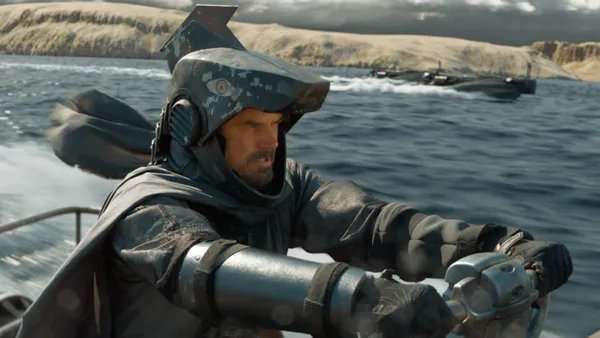
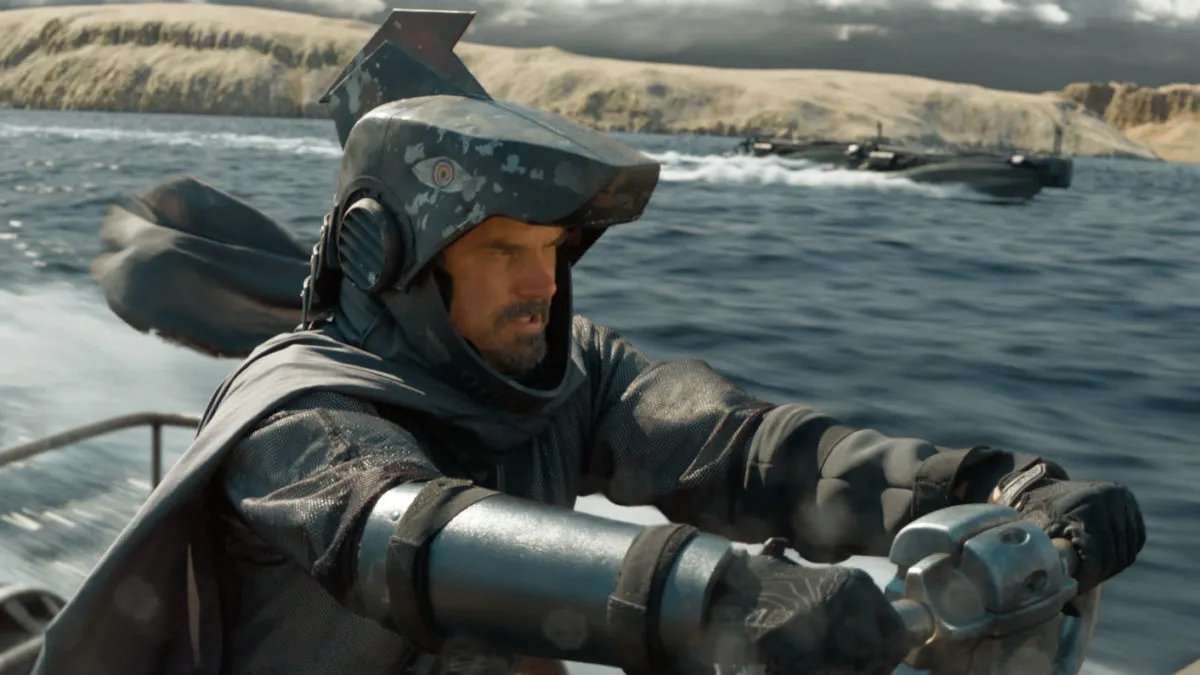
A certain type of low-brow fantasy action used to be Hollywood’s bread and butter, but with a turn towards comic book intellectual property, while they’re still great worldwide performers, a lot of audiences in the international market have been left dry and other players have filled the void. Storm Rider: Legend of Hammerhead, or The Islander, as it is alternatively titled, certainly falls into the category of these “catch-up” Hollywood spectacles. However, while many contemporary attempts from Indian, Chinese, or Russian markets manage to find their own approach – the style of which may seem tacky and odd to westerners – that style has allowed them to carve out a niche of their own.
Although its ambition is commendable, Storm Rider (2026) feels more like an enthusiastic fan wearing an NBA jersey, that found its way to the court and is trying to blend in with the other players, as opposed to embracing its own identity.
As the narration from the prologue informs us, the entire world has been caught by a great flood, turning the entire civilization and the vast land mass into many scattered islands, all loomed over by stormy clouds. One of the last remnants of civilization is the island of Argos, ruled by the so-called “titans” who are, in the timeline we’re following, led by the gloomy, on-the-edge, and seemingly sleep deprived Tarus (Gilles Geary).
The only people let into the city are the ones whose champions win a deadly race of storm riding. The legend has it that one rider, Hammerhead, managed to win by going through to the other side of the storm. However, Hammerhead was pronounced a war criminal, and his story has become more of a faded memory. In the race that opens the film, a man, played by Sergej Trifunović, attempts to relive the legend but dies in the process. Because of that, his island of Fig is forbidden from participating for ten years, all while the titans are in search for the ancient source of life and energy: the Element. Ten years later, the young Neb and Ana (Marco Ilsø and Ivana Dudić) have come of age since the days her father died in a race. The Baroness (Caroline Goodall), one of the titans, decides to sponsor the champion from the Fig island, perhaps because she knows something even young Neb with his psychic visions is unaware of.
As can be seen, Storm Rider is a movie hard to summarise because of its never-ending torrent of exposition. The feeling is akin to watching Joss Whedon’s Justice League, or if we’re sticking to the fantasy genre, the Wachowskies’ Jupiter Ascending or Zack Snyder’s Rebel Moon. The films that were so overstuffed with content in the attempt to merge two movies into one, so the planned cinematic universes could be wrapped up early, making the end results underwhelming and jarring. Storm Rider seems like it’s cut from the same cloth. One could say that even if there never was a plan to make a trilogy of Storm Rider movies, this single film is successful in implying the scale of one, with the word “imply” doing a lot of heavy lifting, given that the voiceover narration leaves no stone unturned.
The structure of neverending exposition seeps into the way a lot of scenes are developed, with a good chunk not really being scenes at all, but a sequence of establishing shots with narration over them. The onslaught of dystopian jargon overwhelms the viewer to a point where, in order to get any enjoyment out of the experience, one has to give up on trying to understand any of it and simply wait for the big race. If that was its only problem, the film would’ve weathered the storm, because the races themselves are executed competently for a smaller Balkan production. However, its biggest problem is that its main protagonist and his love interest are never fleshed out and could basically be boiled down to all too known Hero With a Thousand Faces tropes, making the spectacle feel underwhelming.
The overall concept of storm riding, with metal rods mounted at the front of racing ships to capture storm lightning, makes for an interesting design and storytelling choice. It could be viewed as a part of the lineage of late 19th and early 20th century Serbian scientists who emigrated to the States, and whose inventions have become the stuff of legend in their own right, much like the titular Hammerhead from the movie. On that note, while the general story and its origins are generic to the point where the powerful earth element is literally called “the Element”, the actual setting – mostly shot on the Croatian coast – along with the scrapy, dystopian ship designs and the homey feel of the jam-making household on the Fig island, offers something more. Catching the small fragments of authenticity makes the world feel lived-in, within an otherwise generic story. These small and brief moments are reminiscent of the early scrappy nature of Mad Max movies, or its dystopian water-based derivative Waterworld (1995), and perhaps this dichotomy sums up the Storm Rider as well.
The original Mad Max was conceived as a low budget exploitation as a tactic to make an action movie on the cheap with available resources and exploit what Hollywood otherwise can’t show. Waterworld was, on the other end, one of the more expensive movies of its era, trying to simulate a similar feeling in a studio environment and an oceanic setting. Storm Rider is trapped by this same problem where it tries to apply that scrappy and resourceful sensibility, but it’s realised in a manner of contemporary Hollywood, with a lot of influences obviously lifted off of Christopher Nolan and Dennis Villeneuve, tw of the architects of contemporary tentpole film. This limbo state of it being too expensive while trying to present a cheap and underdeveloped world, it having a dark soundtrack and tone while being incredibly campy, it also being generic while missing to capitalise on all the authenticity at its disposal, makes for a great cinematic contradiction.
In fact, while addressing the journalists after the initial press screening, the director Zoran Lisinac – mostly known as a co-director of a music biopic Toma (2021) – dropped a bombshell that might be the biggest contradiction of them all. The initial concept was a story by Neb Chupin about his grandpa and himself escaping to the United States from the war-torn Croatia in the 90s, where they made a life for themselves by selling home-made jam. No wonder those fragments looked most interesting, yet buried in all dystopian jargon, one wonders what was it all for? Too serious to be aimed at kids, and too childish and unfocused for adults. In the end, the one question lurks over the movie like a storming cloud: who is this for?
Reviewed on: 28 Apr 2026