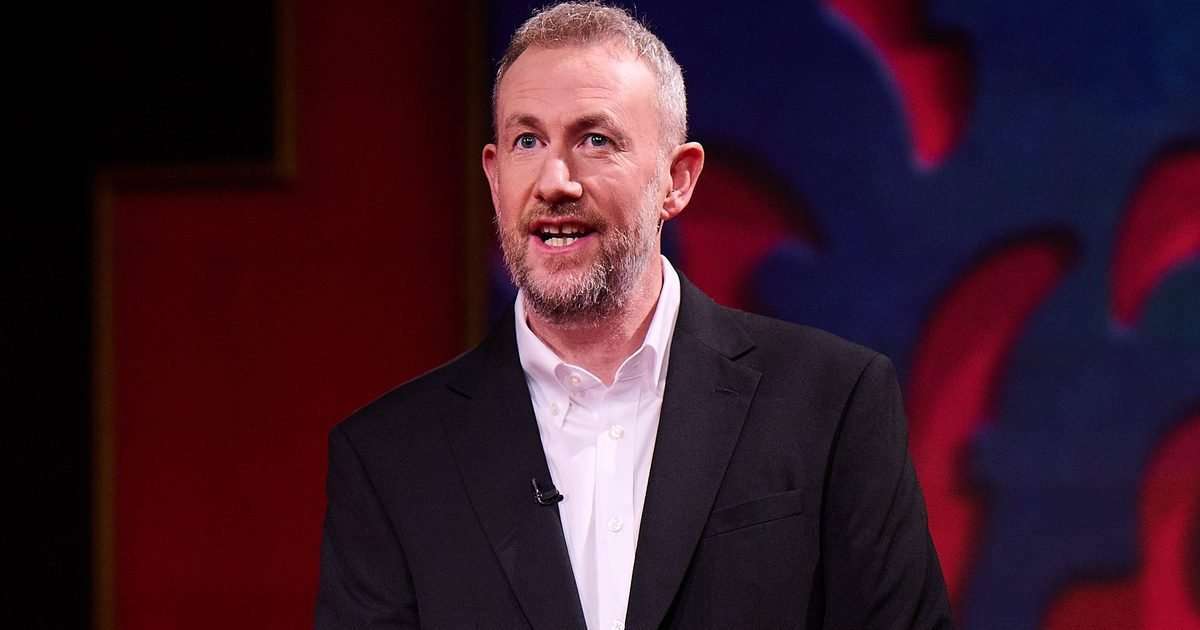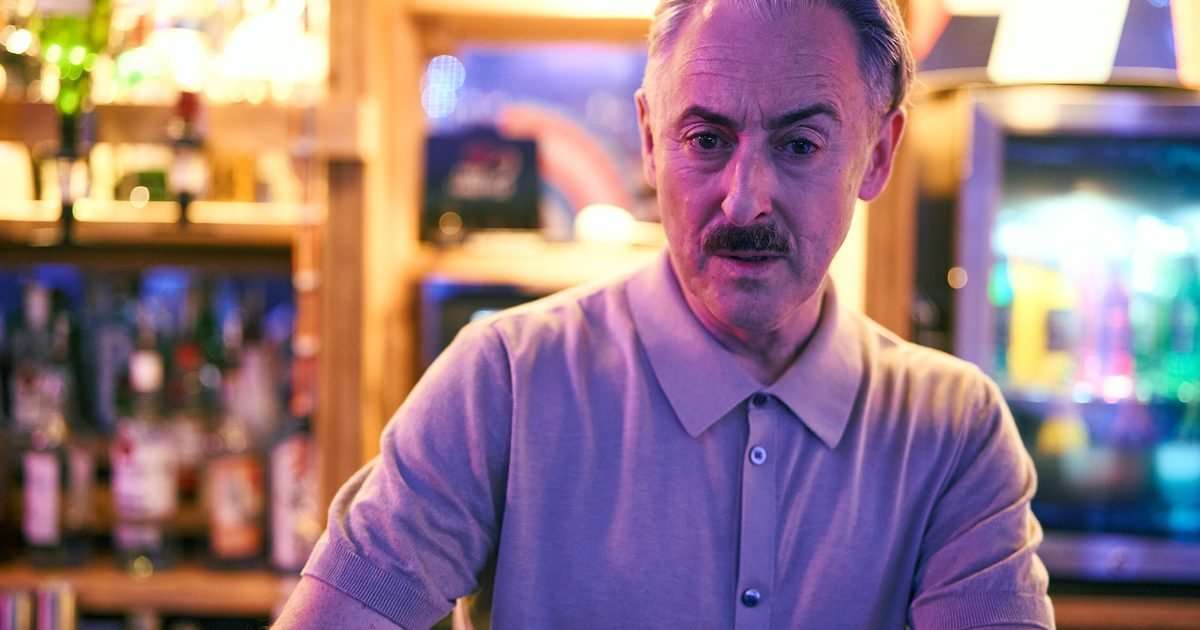
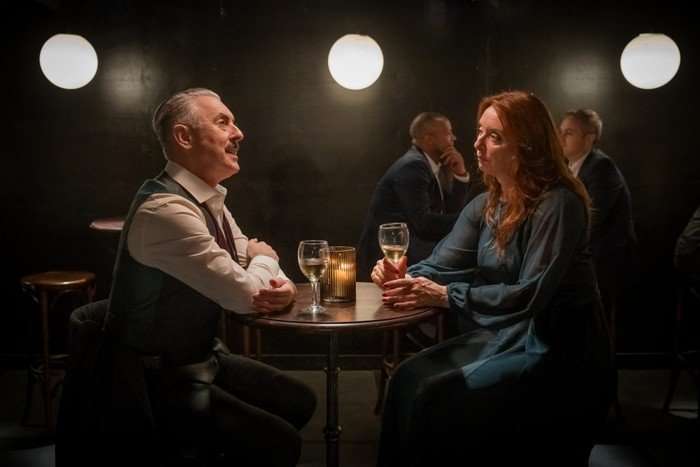
In the coda to Tip Toe, set two years before the terrible chain of events that ends with him hanging from a lamppost with his Birkenstocks lost, Leo (Alan Cumming) laments to Steph (Elizabeth Berrington) in a hushed wine bar basement.
“Every day, every little thing, every tiny little thing that happens, one by one – like banning a book or removing a name or pulling down a flag. I mean, it seems like little things, but there’s a sort of a violence behind it. And you get more and more of these little things, and every single day it builds and builds, and then… I think something big is going to happen.”
Voicing a sentiment that feels disquietingly familiar to me and no doubt to many of Tip Toe’s LGBTQ+ viewers – and indeed to many of its non-LGBTQ+ viewers – Leo reflects that “15 years ago, everything was fine – and now it just feels like it’s ending”.
And he is right, of course. Today, if you’re so inclined, you can find yourself attuned to what amounts to a pre-apocalyptic frequency running through much of the media and public discourse.
It’s there in the shrill prejudices of right-wing commentators and in the cynical interventions of Nigel Farage. It’s there in the invocations of climate change from doom-mongering lefties who can’t even allow you the joy of a sunny Saturday and in the dreary dispatch box pronouncements of Keir Starmer while around him and his political peers, an impatient electorate wants instant, not to mention cost-free, fixes to problems decades in the making.
And it’s there in the 24-hour news cycle, 140 characters, fake news on Facebook, the blink of a TikTok, dog-whistles and Trump posts. Anxiety like infrasound. We seem to live in a perpetual present and yet there’s still the distant sound of a timer, counting down. A persistent clock. An insistent whisper that time is nearly up. Tick-tock, Clarice.
Was any of it there in 2011? If not, what’s different about now?
Personally, the most obvious difference is 15 years. Getting older is great and also terrible. When I hit 40, I got birthday cards that said, “In gay years, you’re dead” and “No one loves a fairy when they’re 40” (thanks Mum!). There is a world of difference between being 35 and being 50, and the intervening years pass like scenery through a train window. If you’re 35 or younger, chances are you won’t have experienced what Brené Brown calls “the developmental milestone of midlife”. Well, buckle up, bozos.
Brown says: “This is when the universe comes down, puts her hands on your shoulders, and pulls you close and whispers in your ear, ‘I’m not f**king around. You’re halfway to dead. The armour is keeping you from growing into the gifts I’ve given you. That is not without penalty. Time is up.’”
If you haven’t experienced this, it’s quite the epiphany, Tiffany. Once you get over how it feels like a curse, it’s actually a blessing. You run out of f**ks to give, cease caring what other people think of you, and stop putting other people’s emotional needs ahead of your own. Which you need to do when your friends start dying and you realise that, in the words of JM Barrie/Battlestar Galactica’s Number Six, “All this has happened before, and all this will happen again.” I suggest you lean in.
Russell T Davies is a generation older than I am and, despite his experience with time travel courtesy of Doctor Who, is subject to the joys and indignities of ageing just like everyone else. While Queer as Folk burst with youthful energy and Cucumber buzzed with middle-aged angst, Tip Toe resonates with ‘This? Again? FFS’ energy.
So there’s that.
Along with the joys of one’s own (relative) youth, there are real world circumstances to consider. In 2011, the effects of the Equality Act (2010) were being felt. It protects people from being discriminated against at work and in wider society in the UK, enshrining in law nine protected characteristics, including sexuality, sex and gender reassignment along with age, disability and others. It worked on both legal and symbolic levels.
Similarly, the impetus towards same-sex marriage showed no sign of abating and would come to fruition in 2014, ten years after civil partnerships were legalised in 2004. However implausibly – given the venom with which the Tories championed section 28 and demonised gay men during the Aids crisis – this occurred under a Conservative government. Those were strange, heady days indeed.
In the UK, there was never a better time to be LGBTQ+. In, fact there’s still never been a better time to be gay here than today. We have more freedom, more opportunity and more reasons to celebrate than ever (even if June as Pride Month is entirely an American invention when most British Pride events happen in July and August).
This relatively optimistic outlook can be tempered by statistics. While overall acceptance has grown, still only 47 per cent of LGBTQ+ people feel they can fully be themselves to all family members. Societal and health inequalities persist – especially when it comes to mental health – but more positively, hate crime is down.
According to the Home Office, in the year ending March 2025, sexual orientation hate crimes fell by two per cent and transgender hate crimes fell by 11 per cent (compared to a six per cent increase in race hate crimes and three per cent rise in religious hate crimes). Perhaps I should rephrase, there’s never been a better time to be gay and white.
Want to see this content?
This page contains content provided by Google reCAPTCHA. We ask for your permission before anything is loaded, as Google reCAPTCHA may use cookies and other technologies. To view this content, choose ‘Accept and continue’ to allow Google reCAPTCHA and its required purposes.
And yet, today feels febrile and fractious – “with a sort of violence behind it”. So many people are either spoiling for a fight or eager to be offended. We could blame trans people – all 262,000 of them in the UK (according to the 2021 census). After all, in 2016, British trans people enjoyed broad public support and the country was becoming increasingly tolerant. According to the British Social Attitudes survey, almost six in 10 people agreed that a trans person should be able to change the sex on their birth certificate with only one in ten disagreeing.
But today, support for changing birth certificates has fallen to 24 per cent, while nearly half of Britons said attempts to ensure equal opportunities for trans people had gone too far. In April 2025, the Supreme Court ruled that, while trans people are protected from discrimination under the gender reassignment provisions, transgender women are not legally women and biological sex trumps gender. More than half of Britons agree with the ruling. What happened?
It might have been trans activism, going too far, too fast, demanding too much while declaring ‘no debate’. Stonewall’s now-infamous 2015 decision to adopt this position can now be seen as disastrously self-defeating. Or it might have been the equally ferocious, equally intransigent, entirely understandable response to Stonewall’s position from gender-critical feminists and others – including many LGB people, some of whom reject any association with T outright and some of whom aren’t convinced by theories advanced by trans advocates and activists.
Davies’s commitment to the T, however, is long-standing. Accepting an award from Attitude magazine in 2021 for his Aids drama It’s a Sin, he criticised the LGB Alliance, and spoke some of his speech in only three-letter words to make his point.
Want to see this content?
This page contains content provided by YouTube. We ask for your permission before anything is loaded, as YouTube may use cookies and other technologies. To view this content, choose ‘Accept and continue’ to allow YouTube and its required purposes.
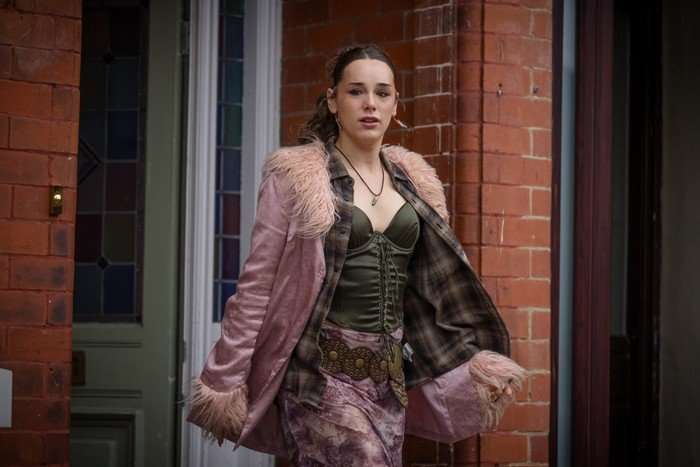
In Tip Toe, he aligns the fates of Leo and Zee (Iz Hesketh), with the former sacrificing himself to save the latter, cementing the solidarity of the LGBTQ+ communities far more securely than it exists in reality. For balance, Stephanie is the show’s gender-critical – or as she might prefer, sex-realist – voice.
In the real world, it’s not so much about balance as brutal, bloody battle, with much of the subsequent trans-terf warfare fought on polarising, nuance-free social media – use of which, not coincidentally, rose exponentially in the decade from 2011. I don’t get paid enough to say what I think on this unbelievably toxic subject, but it is interesting to note that some people on both sides of the aisle have found real purpose in conflict – not to mention notoriety and revenue streams.
The trans “debate” – which in itself is a contentious term, minimising and obscuring the fact that there are actual real people with feelings and families and futures involved here – is worth more time and space than we have here to discuss in good faith. So why don’t we agree to blame trans people and women for the troubles of today?
Kidding. And yet I’m trying to make a serious point – that this clash, as significant as it is, is actually an emblem of what has been the single most significant change to British culture in the last 15 years and what I believe is responsible for the violence and impending ending that so concerns Leo in Tip Toe: the arrival in the UK of culture wars.
According to King’s College London’s Bobby Duffy and Kirstie Hewlett, who have done excellent work on the subject that I’d encourage you to seek out, from 2015 to 2020 saw a “huge surge in media coverage of culture wars”. In 2015, there were only 21 articles in mainstream UK newspapers that discussed a “culture war”. In 2020, there were 534. In 2025, there were thousands.
Discussing the work of sociologist James Davidson Hunter who first popularised the language of “culture wars” in the 1990s in America, Duffy and Hewlett point to his definition as an articulation of the deep-seated tension that had emerged in the US between “orthodox” and “progressive” worldviews. A ‘culture war’ signals much more than disagreement. In Hunter’s conception, it describes a sense of conflict between two irreconcilable worldviews in what is “fundamentally right and wrong about the world we live in”.
And in the contemporary UK, the culture wars are everywhere, all the time and all-encompassing, pulling in everything from Strictly Come Dancing to Paddington Bear.
Of course, disagreement – over class, race, religion and politics – is nothing new. But irreconcilable worldviews and regarding anyone who doesn’t adhere to your belief system as an existential threat? That is definitely a new thing. (Is everyone a drama queen nowadays?)
What makes this moment especially dangerous is the fact that many people increasingly inhabit separate informational worlds – consuming different media, following different online communities and encountering vastly different versions of reality. Algorithms turn this polarisation into architecture. The internet and social media promised connection and community. They have delivered estrangement and isolation.
In tandem with the decline of shared civic institutions that once brought together people from different backgrounds – churches, trade unions, youth clubs, local associations – the diminishing of public spaces – parks, high streets – and the swingeing cuts to local public services, the opportunities for communal life, for community, have been dramatically reduced.
The sociologist Robert Putnam famously described the phenomenon as “bowling alone”: people remain active as individuals but become disconnected from collective social networks. And with disconnection comes fear – and fear is a great motivator. It makes people easy to manipulate, to enrage, to lie to, to persuade people to operate on the basest of instincts. Fear is undoubtedly a weapon. More important, however – and this takes us to the very heart of how Tip Toe resonated with me personally – fear is a shield. People hide behind it.
Fear is a shield in the same way as the culture wars are a sideshow, a distraction whipped up by what we used to call the right to divert from the fact that the promises they’ve been peddling for the last 50 years about neoliberal capitalism are in fact lies. Lies told to gain power, to win elections, to put on a show of levelling the playing field so that anyone can achieve anything, while actually putting mechanisms and structures into place to keep the poor poor and enrich the rich further. A rising tide doesn’t lift all boats. There is no such thing as trickle-down theory. If there were, why are the richest people in the country – in the world – richer than ever and the poorer even more skint?
Either the system doesn’t work properly, or the system works exactly as it’s supposed to and the common man and woman have been sold a fiction. Billionaires are a symptom of a sick society but we’ve become so brainwashed by the pernicious persuasiveness of the predominantly right-wing media that we look at them as benign or even admirable forces. They are emblems of exploitation and injustice incarnate.
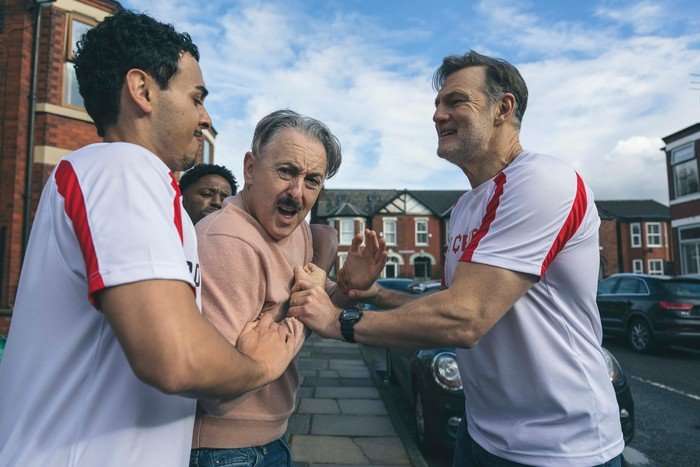
So much is made in Tip Toe about the pressures on both Leo and his neighbour turned nemesis Clive (David Morrissey) of running a business, and economic uncertainty is as much a factor in Clive’s radicalisation and the crisis in masculinity from which it arises as shame, repression and homophobia. Looking at Leo’s 15-year timeline between feeling fine and feeling like it’s ending, perhaps the latter is actually the feeling of the wheels falling off capitalism. It’s certainly unsustainable, which should make for an interesting 21st century. As philosopher Mark Fisher noted in his 2009 book, Capitalist Realism: it’s easier to imagine the end of the world than the end of capitalism.
There’s no doubt that the effects of 2010’s Equality Act prompted a backlash from conservative quarters, but those same quarters were desperate for something to hide their decades-old deception behind. A key precursor to Leo’s timeline is 2008 – the year of the financial crash, the consequences of which have played out over these last two decades. The results, and occasional excesses, of the Equality Act have been weaponised to conceal the shocking injustices of the bail-outs, and the subsequent years of politically motivated austerity inflicted on the poorest people in the country.
In the end, Leo is asking the wrong question when he ponders, “In the old days, if they hated us, we could say it’s due to a lack of visibility… but what if we got it wrong? What if they see us and they still don’t like us?”
The thing is, it’s not about us. The right, or rather bigger question, is the question we must always ask when minorities find themselves besieged or culture wars rage: cui bono? And the answer to that is to be found in a classic movie almost as old as I am – follow the money.
Tip Toe is available to watch on Channel 4.
Add Tip Toe to your watchlist on the Radio Times: What to Watch app – download now for daily TV recommendations, features and more.
Check out more of our Drama coverage or visit our TV Guide and Streaming Guide to find out what’s on. For more TV recommendations and reviews, listen to The Radio Times Podcast.