Hospital procedural The Pitt is renowned for being one of the most accurate medical dramas ever made.

The show’s gritty realism is built into its premise, which follows the staff of an emergency department in Pittsburgh, Pennsylvania hour-by-hour across a single 12-hour shift.
But it also comes from The Pitt’s remarkable dedication to detail, with every procedure, prescription and prop rooted in the everyday reality of healthcare professionals.
Much of The Pitt’s authenticity is inspired by medical consultants like Dr Elizabeth Ferreira, a working emergency medicine physician who advises the creative team on the best way to bring her job to life.
Working closely with the production, Ferreira and her colleagues ensure that everything from the movement of an incision to the explosion of a backed-up bowel reflect how emergency departments actually operate, rather than the way they are often simplified for television.
Ahead of The Pitt’s UK finale, Dr Elizabeth Ferreira talks us through the process, which starts from the script and ends with “naturals” like Noah Wyle blurring the line between actor and doctor…
Admitted
I was born and raised in Honolulu, Hawaii, but after medical school I moved to Los Angeles for my emergency medicine residency at UCLA’s [University of California, Los Angeles] Ronald Reagan Medical Centre. My decision to go into emergency medicine was shaped by my father passing away after coming through the emergency department.
The reality is that nobody plans to come to the emergency room. If you’re there, it’s often one of the worst days of your life. I still remember the physicians and nurses who made that awful day a little easier. That stayed with me.
Falling into The Pitt
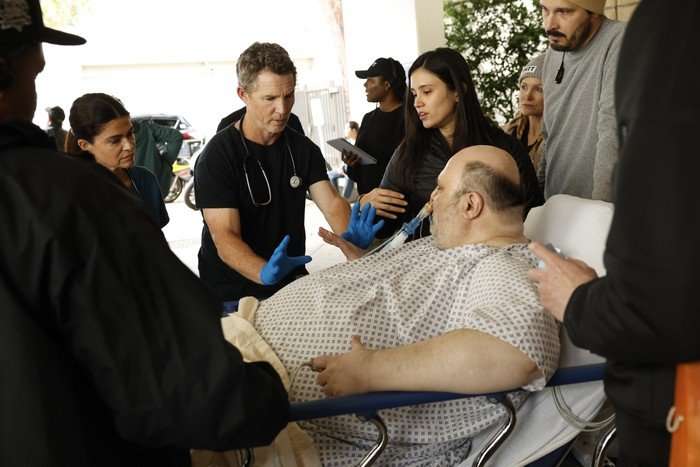
I became involved with The Pitt through UCLA. A lot of alumni from the programme have worked on medical dramas over the years and one of the show’s medical consultants, Dr Ariel Wu, reached out to see whether I’d be interested in joining the team. My role covers a lot of different areas, from helping with rehearsals and procedural choreography to making sure the medical aspects of the show feel as authentic as possible.
A double shift
I still practise emergency medicine full-time. There are four medical consultants on The Pitt and the episodes are divided between us, which allows everybody to keep working clinically while contributing to the show. When I’m assigned to episodes, I cut back to roughly half-time because the commitment is so intense. It’s a balancing act between night shifts, prep days and filming. When I’m working on the show, I probably sleep about as much as I did during residency!
On call
When we’re shooting, the days are long. The filming schedule is usually nine days, and those are often 12-hour days. We’re there throughout the process, either helping with rehearsals, advising on procedures or making sure everything remains medically accurate. Once the director starts filming a scene, we’re often moving ahead and preparing the next one. The pace of production means you’re always thinking one scene ahead. It’s a constant balance between supporting what’s being filmed and preparing what’s coming next.
Charting
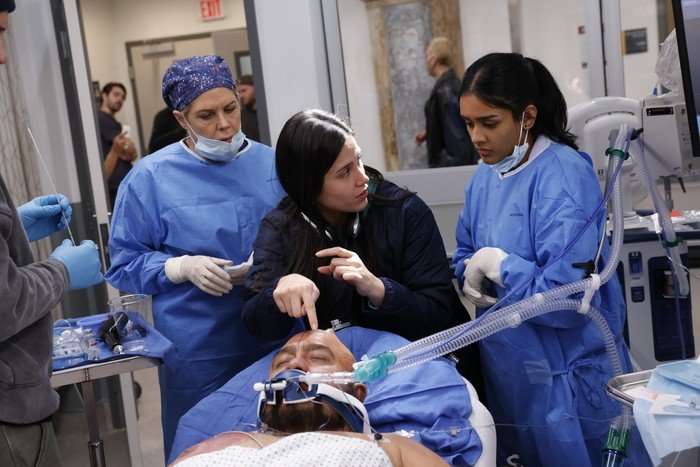
We usually receive the script about a week before prep begins, and we’ll spend hours breaking down every medical detail in the episode. We create an enormous document for all the departments – props, make-up, special effects, wardrobe and more. It can easily run to 20 pages!
The level of detail is astonishing. We specify everything, from where a bandage should sit to exactly how much blood should be visible on a gown. We discuss how sweaty a patient should be, whether they’re breathing quickly, how their condition changes throughout the episode and how those changes should look on screen. By the time we get to the concept meeting, every department has a detailed medical roadmap for what’s required.
Anatomically correct
During prep we’re constantly meeting with the make-up and prosthetics teams to work out how injuries, procedures and medical conditions will be shown on screen. We break procedures down step-by-step and explain exactly what needs to happen anatomically. If we’re showing an open chest, we need the heart to beat realistically and the blood flow to look correct. If a lung is injured, we need it to move and collapse in the right way.
We’ll send reference videos, medical explanations and detailed notes. Sometimes we’ll discuss whether something should be done practically or enhanced with CGI, but whenever possible we try to create things physically.
Poonami
Special effects meetings are always entertaining, because we’ll be discussing something completely absurd with absolute seriousness. In season two, there is a patient with severe constipation and the doctors need to disimpact her. I’ll say, “The patient is impacted, and when that blockage clears, the stool needs to come out with explosive force!” Then I’ll look across the room and see the special-effects team processing that I’ve just asked them to create a highly sophisticated poop cannon!
Want to see this content?
This page contains content provided by Google reCAPTCHA. We ask for your permission before anything is loaded, as Google reCAPTCHA may use cookies and other technologies. To view this content, choose ‘Accept and continue’ to allow Google reCAPTCHA and its required purposes.
Medical school
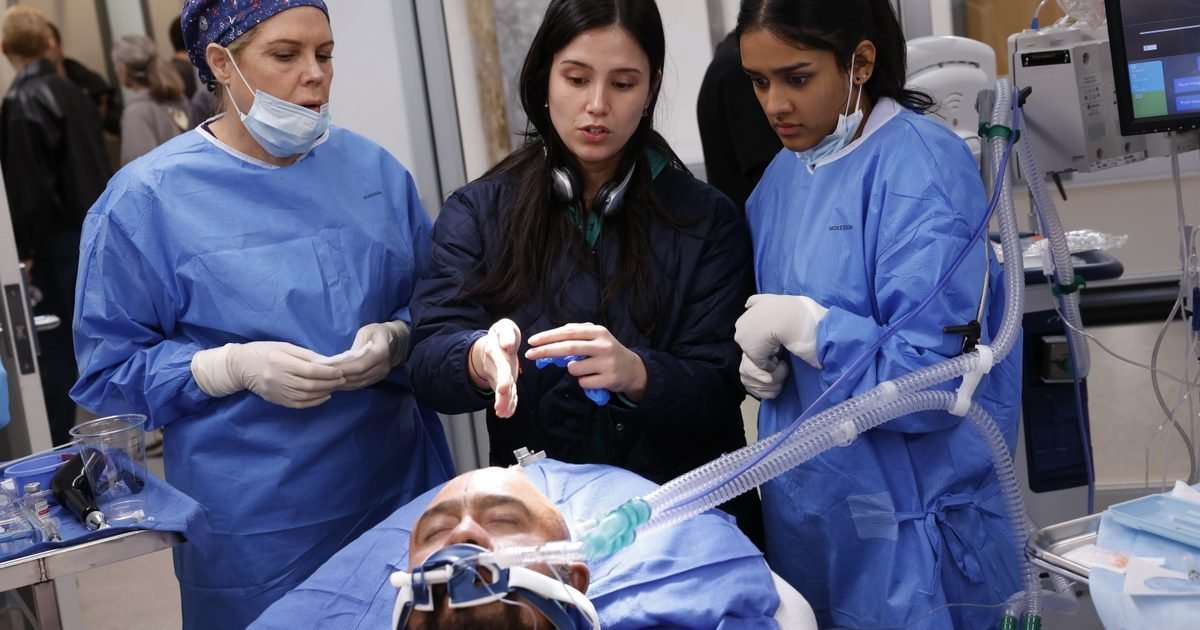
One of the most important parts of my job is helping the actors learn the medical choreography. For the major procedural scenes, we create detailed breakdowns and rehearse them almost like dance routines. We call them “trauma days”, although that’s become a bit of an inside joke because they’re traumatising for us as well!
For those scenes, we’re often going line by line and movement by movement, explaining exactly where someone’s hands should be, what equipment they’re using and what should be happening medically at every moment.
We’ll rehearse individually with actors, then as a group, and ideally with the patient actor present too. That way everybody understands who is touching whom, what cues they’re responding to and how the patient’s condition should affect their behaviour. Sometimes we’ll run a scene five or ten times before everyone is comfortable.
Wyle old fox
Noah Wyle requires the least rehearsal of anybody. He just understands how doctors move, speak and carry themselves. Dr Robby feels completely natural because Noah has such a strong instinct for the role. Even the way he conducts himself on set reminds me of experienced attending physicians I’ve worked with in hospitals!
Slo-mo ECMO
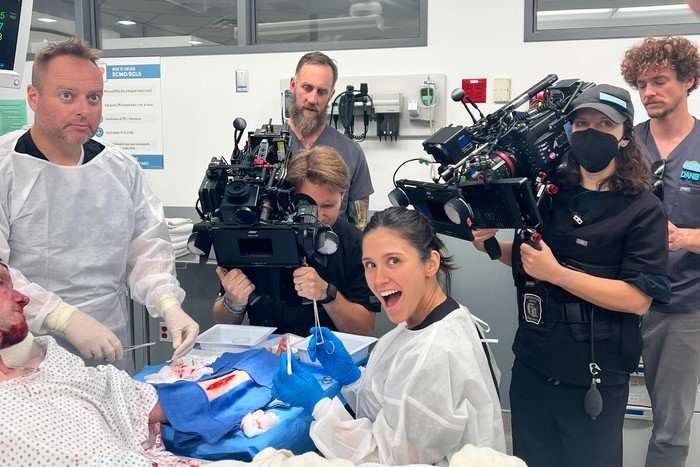
One of the most challenging sequences involved ECMO [Extracorporeal Membrane Oxygenation], which is a machine that temporarily performs the work of the heart and lungs for critically ill patients. It’s a highly specialised procedure that requires enormous amounts of training in real life.
We were filming a major ECMO sequence late in the day and some of the actors involved were new to the show and had to learn a very technical procedure under significant time pressure. We focused on the key visual beats: inserting the cannulas, operating the machine and showing the effects on the patient.
The scene ended up looking great, but behind the scenes it was one of those days where everybody was working flat out to make something incredibly complicated happen within a limited amount of time.
Doctor Know-It-All
The biggest thing that medical dramas tend to get wrong is the idea that doctors can be multiple specialties at the same time. A general surgeon would not typically also be a neurosurgeon. That is one thing The Pitt does very well. I really appreciate the realism of the idea that when you’re in emergency medicine you only have certain pathways. You’re a jack of all trades. You’re not a specialist. One doctor cannot do it all, as much as we would all like to think we can!
Gallows humour
One thing The Pitt captures brilliantly is the sense of humour that exists in emergency medicine. The humour is much darker than most medical dramas are willing to show, but for me it’s one of the most authentic aspects of the series.
People sometimes question why certain characters, particularly Dr Santos [Isa Briones], can seem so blunt or irreverent. The reality is that when you’re exposed to trauma and tragedy every day, humour becomes an important coping mechanism. If you can’t find healthy ways to process what you’re seeing, it can consume you.
Life and death
There are so many moments in The Pitt that feel authentic to me, but one that really stands out involves Dr McKay [Fiona Dourif] and a patient who is dying from cancer. McKay helps administer the medication that eases the patient’s final moments, but she isn’t able to stay for her death because the emergency department is moving too quickly and other patients need her attention.
A lot of viewers responded to that scene, and I think it’s because it reflects a difficult reality of emergency medicine. As much as we would like to be present for every important moment, we often can’t be. The work keeps moving, and another patient needs your help. There’s very little closure.
The Pitt season 1 is available to watch on HBO Max in the UK now. Season 2 continues releasing new episodes weekly on Thursdays. Subscribe to HBO Max from £5.99 a month.
Add The Pitt to your watchlist on the Radio Times: What to Watch app – download now for daily TV recommendations, features and more.
Check out more of our Drama coverage or visit our TV Guide and Streaming Guide to find out what’s on. For more TV recommendations and reviews, listen to The Radio Times Podcast.