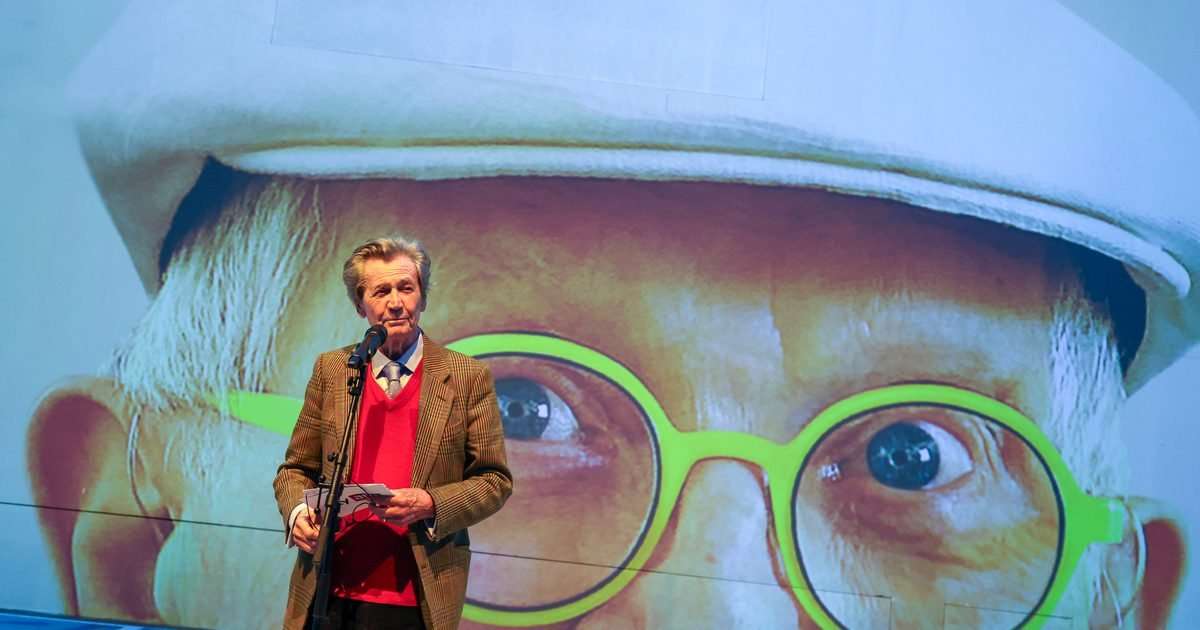
David Hockney, one of Britain’s most celebrated and influential artists, has died at the age of 88.
The Bradford-born painter, whose vivid depictions of Los Angeles swimming pools helped define a new visual language in the 1960s and ’70s, remained restlessly inventive throughout his career, later turning his eye to the landscapes of Yorkshire and Normandy, as well as embracing photography, video and iPad drawings.
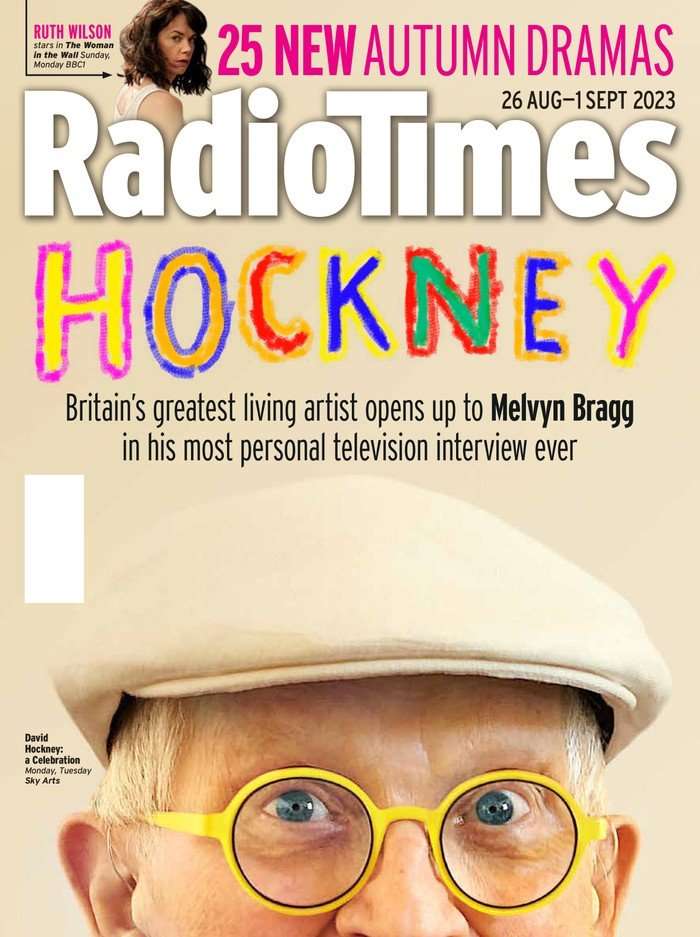
In 2023, Radio Times spoke to Melvyn Bragg ahead of a major Sky Arts celebration of Hockney’s life and work. Bragg had filmed Hockney across almost 50 years for The South Bank Show and beyond, capturing the artist through multiple creative reinventions – from California to Bridlington to Normandy.
Revisiting that conversation now, Bragg’s words feel especially resonant. “He’s unique,” he said. “One of the greatest painters of our time, full stop.”
David Hockney’s portrait of Melvyn Bragg stares down at Melvyn Bragg and Bragg stares right back. “David’s quite strict,” the broadcaster, author and South Bank Show creator says, as he considers the picture on his living room wall. “You do have to keep very still, and he doesn’t like you to talk. But I think he caught something.”
It’s a pleasantly knobbly face, rendered in warm colours. A skew-whiff right eye emphasises Bragg’s lifelong curiosity, a flash of red at the shirt collar hints at his sartorial flamboyance and all crammed under a crown of luxuriant black hair. Hockney has painted famous people he doesn’t really know, most recently Harry Styles (“He was just another person who came into the studio,” Hockney cheerfully told Vogue afterwards), but this picture, created in 2010, feels like an act of friendship. At the bottom, above his signature, Hockney has written, “First try for Melvyn”.
Bragg and Hockney have been making portraits of each other for nearly half a century and most of the sitting, so to speak, has been done by Hockney. The artist has been the subject of a remarkable six episodes of The South Bank Show, the culture programme Bragg launched in 1978 at London Weekend Television and, following a short hiatus, took to Sky Arts for a new life in 2012. Although, as we’ll see, not for much longer. “Thank God I did those films with him,” Bragg says, as we sit opposite the portrait. “Because his work changes so dramatically with time.”
Few outside Hockney’s studio have caught such a vivid glimpse of the digressions and innovations of the artist’s long career and now the two men, Bragg at 83, and Hockney, 86, are about to deliver their most intense encounter yet – two days of Sky Arts programming that will feature interviews and a documentary that follows Hockney’s career from the streets of 1950s Bradford, via the Swimming Pool paintings in Los Angeles, to the converted farmhouse studio in Normandy with four acres of fruit trees where he presently lives and works with a team of assistants. “He is very open about everything,” Bragg says. “There’s nothing concealed.”
To mark this noteworthy event, I’ve come to Bragg’s London house, which he shares with his third wife, Gabriel. Even at home in slacks and jumper, there are hints of the peacock style that once attracted Spitting Image puppet-makers and newspaper caricaturists, but Bragg has lost some of the vigour that is evident in Hockney’s portrait. “I was very, very seriously ill for two and a half years,” he says. “I lost an awful lot of weight. I had some very bad cancers. I had one really terrible infection that nearly did for me. In between was something like pneumonia, and God knows what else. It just kept coming. It was retribution for having a profligate life, a reckoning. I still have a long hangover from it, as it were, but that’s not going to stop me from doing what I want to do.”
Unlike his contemporary, Esther Rantzen, who recently revealed she has stage four lung cancer, Bragg didn’t go public with his diagnosis. “I understand why some people do and I admire them. I think a lot of women will say, ‘Well, if Esther can get through it, then so can I.’ And that matters. I just didn’t want to talk about it. And then it got out because I couldn’t go to places and I couldn’t do things. I can now it’s getting better, but I’m massively weaker in terms of walking and getting tired in the evenings.”
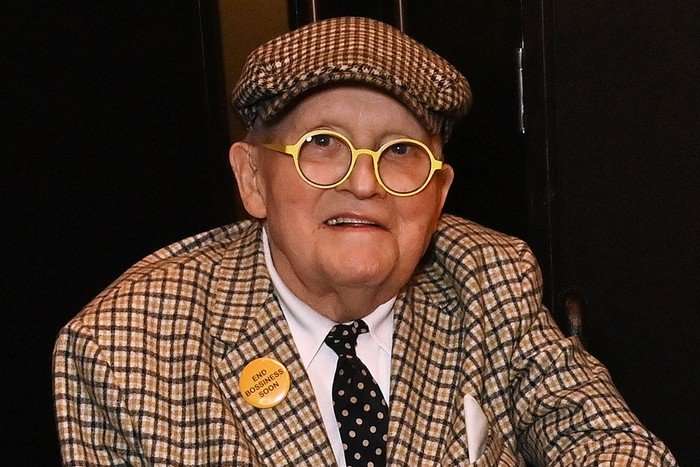
The weariness necessarily limited where Bragg could go for the documentary and interviews. Twelve-hour flights to LA were out, but then he had already been there with his cameras, staying at Hockney’s home near Mulholland Drive in 1983 just as the artist discovered a new method, “joining”, where he made large images by amalgamating smaller photographic prints.
There Bragg observed a life that suggested West Coast hedonism but was mainly North Country industry. “He was working a lot and then he would go out and do whatever it is he did. I didn’t track him in those things,” he says. “America was made for him. The gay scene was much more open and there was so much light. He told me that when he arrived, he realised America didn’t have its painter, like Venice had Tintoretto, and he thought, ‘Well, I could do that.'”
Paintings like Splash (1966) and Portrait of an Artist (Pool with Two Figures) (1972) soon fulfilled that ambition. “He became America’s famous painter. He was just utterly dedicated. I remember watching him and thinking, ‘I should work a lot harder at what I’m doing.'”
Similar thoughts came 27 years later when Bragg was staying with Hockney at his home in Bridlington to make a film, and also to sit for the portrait that now hangs before us. “I went into his room and he had painted ‘Get up and work’ in different coloured letters near the bed. That was his philosophy and he said it to me: ‘You get up and you start work.'”
One morning, shortly after dawn, Hockney grabbed Bragg and insisted they immediately go up on the hills of the nearby Yorkshire Wolds, telling him: “We’ll have breakfast later, the morning is beautiful now. Nobody will be there. If it was in Japan, it’d be crowded, but this is Yorkshire. Nobody knows what they’re missing. Come on!”
Bragg was in Bridlington just as Hockney was enjoying another of his creative rebirths. The artist had moved to the same East Riding coast where he spent childhood holidays and created a vivid body of landscapes like Arrival of Spring in Woldgate and multi-camera video works inspired by the Wolds. As well as a South Bank Show special, it led to an acclaimed sell-out exhibition at London’s Royal Academy in 2012.
Within a decade, Hockney was back at the RA with The Arrival of Spring, Normandy, 2020, an exhibition of 116 works celebrating nature’s exuberance. The images were created on Hockney’s iPad during lockdown, in the garden where he has enjoyed a Matisse-like burst of later-life creativity. If that seems strong praise, Bragg insists Hockney is good enough to stand such comparisons.
“He’s unique. One of the greatest painters of our time, full stop. His reputation is often higher in other countries than it is in his own. I don’t know if it’s something about the English, but when people say, ‘Oh, it’s very entertaining,’ they mean lightweight. That’s b******s, Hockney isn’t at all lightweight. But that’s the implication, that if you do angst you’re heavyweight, and if you do something that’s full of life and joy, you’re lightweight. Well, it isn’t.”
It’s as close to cross as Bragg will get today and reminds me of a moment in the documentary when Hockney rails against being told not to smoke, saying “I don’t like bossiness!” The two men are much alike. Both working-class Northerners, one from Bradford in the West Riding of Yorkshire, the other from Wigton in Cumbria, they are, along with Leeds-born Alan Bennett, the surviving remnants of the northern proletarian cultural explosion in the mid-20th century that seems, from the remove of socially and geographically stratified contemporary England, hard to credit.
Both came south to London – Hockney to the Royal College of Art and then on to LA. Bragg stayed in the capital, rising Dick Whittington-like from BBC trainee to member of the House of Lords. As part of Huw Wheldon’s BBC Monitor team in the 1960s he made a series of era-defining television arts films, many – including The Debussy Film (1965) starring Oliver Reed – with regular collaborator Ken Russell. In 1978 he launched The South Bank Show, an arts programme that treated popular culture and high culture with equal seriousness. The first series began with Paul McCartney but also featured Hockney, whose LA works and the London dual-portrait Mr and Mrs Clark and Percy (1971), had crossed over into the wider public consciousness.
Bragg keeps a home in Cumbria, but Hockney remains the more ostentatiously Northern of the two men. Retaining a voice of deep Bradfordian dryness, he bestrides the world art scene with a flat cap glued to his head. Throughout his career Hockney has returned to Yorkshire, often to paint his mother Laura’s portrait. His parents were Methodists, his father Kenneth’s faith leading to him becoming a conscientious objector in the Second World War. As the street they lived in had been bombed by the Germans and other families had seen their menfolk go to war, this made Kenneth extremely unpopular and effectively unemployable. To make a living, Hockney senior set up a pram repair business in the cellar of the family home, while Laura assisted and kept home for Hockney and his four siblings.
Want to see this content?
This page contains content provided by Google reCAPTCHA. We ask for your permission before anything is loaded, as Google reCAPTCHA may use cookies and other technologies. To view this content, choose ‘Accept and continue’ to allow Google reCAPTCHA and its required purposes.
In the documentary, Hockney recalls watching his father finishing each repaired pram with a lick of colour and becoming aware of the magically transfiguring power of paint on brush. “He used to draw on the kitchen lino when he was a child crawling around,” says Bragg. “So it was always there. It’s what he wanted to do and when he decides what he wants, he won’t budge for anybody. At Bradford Grammar he discovered that if you were in the A stream, which he was, you got one art lesson a week, but if you were in the C or D stream, you got four or five. He deliberately made his grades go down until he ended up in the D stream, so he could have five art lessons a week. This is an 11-year-old!”
Bragg tells this story with wonder and some affection; does he like Hockney very much? “Oh, yes. Unless you’re an idiot, you can’t not like him. He’s deeply likeable. He’s funny.”
I ask if he recalls the first time he met the artist and he struggles to pinpoint the precise moment. “That’d be in the late 60s. He was a figure in the social landscape, I bumped into him once or twice.”
What has stuck in his mind is a later encounter at an annual formal dinner for one of the big London galleries. “There were speeches and candlelit tables. It got a bit stuffy so I went outside for a breath of fresh air, and there was David having a fag. He looked at me and said, ‘You’ve got to come out to smoke. They said if I smoke inside, it’s a fire risk.’ Then he paused and said, ‘Do you know how many candles they’ve got lit in that room?’ There’s a lot of Northern comics who would kill for the sort of timing David has.”
Sky Arts have not given this week’s documentary and interviews a South Bank Show badge, but that is clearly how Bragg thinks of them. As such, this will be a goodbye. Sky Arts and Bragg have agreed there will be no more South Bank Shows. “It’s a huge journey, 45 years of it,” he says. “But I’m 84 next year, and I can do without it now. I thought, ‘Well, fine. That’s the way it goes.’ It’s been a fantastic privilege. And working with such people. I mean, Christ, what a life! But yes, this is it.”
He may be letting go of one immensely successful broadcasting project but another continues. This autumn will mark the 1,000th episode of In Our Time, the Radio 4 programme where, at Bragg’s prompting, academics tell us things that we didn’t realise we wanted to know. The show’s trick, he tells me, “is only to use teaching academics”, people who are used to talking in front of a room full of students. He will also appear on This Cultural Life this weekend on Radio 4, looking back to his own youth in Wigton, a time of pie and pea suppers and successfully studying for Oxford..
But if Bragg and Hockney are a bit creakier these days – the artist suffers from severe hearing loss – it’s perhaps to our benefit as viewers. “The thing that seemed to be an obstacle turned out to be a huge advantage,” Bragg says. “I knew I would have to do two things: sit much closer to him than I usually do, which maybe makes people uncomfortable, and also speak rather loudly, which I don’t like doing. It meant that we had to concentrate the camera on him, because I didn’t want cutaway shots of me barking away. But he was hearing everything I said, and we were leaning into each other, because he wanted to listen and I wanted to hear.
“I think it’s a very intense portrait, looking at his expressions and the way he moves and thinks. I’m very proud of that. I think we got more than what he says; we got the underlying man there.” It has been a long and rich encounter; two men looking into each other’s faces seems a good way to end it. Last try for Melvyn.
Check out more of our Documentaries coverage or visit our TV Guide and Streaming Guide to find out what’s on. For more TV recommendations and reviews, listen to The Radio Times Podcast.