Adam Page on the J-horror popularity explosion of the late 90s and its impact on Hollywood…
I know I’m starting this with a generalisation, but there is an odd sort of arrogance that comes with being American. It’s not malicious, it’s more of a quiet, deeply held assumption that the best ideas of the world will find their way to their shores, cleaned up and subtitled out of existence, repackaged into something more palatable. It’s done with food, and with music. And spectacularly, with all the grace of a wrecking ball wearing a polo shirt, it was done to Japanese horror cinema.
But let’s back up for a moment. Because before Hollywood got its hands on any of it, something truly extraordinary was happening in Japan in the 1990s. It was something which didn’t need our approval, definitely wasn’t designed for comfort, and really, didn’t give a damn whether we understood it or not.
To understand J-Horror, the loose, critical shorthand for the wave of Japanese supernatural horror that crested between roughly 1995-2005, we have to understand that it didn’t emerge from a vacuum, but a culture.
In the late 1980s and early 90s, Japan had been riding an economic bubble of almost hallucinatory proportions. That bubble then burst, and with it came a certain type of social dislocation. The promise of post-war prosperity had faded into corporate exhaustion, rising rates of suicide, and a generation that was growing more alienated from the rigid hierarchies their parents sacrificed everything to climb. Into that psychic wound, horror poured in.
Japanese horror was drawn from a well much older than cinema. The yūrei, vengeful spirits, particularly female ones who were done wrong in life and returned in death with an agenda, had been haunting the folklore of Japan, along with kabuki theatre and woodblock prints for centuries. Onryō, ghosts specifically animated by strong, unresolved emotions like rage or sorrow, were not invented by Hideo Nakata. He just handed her a videotape.
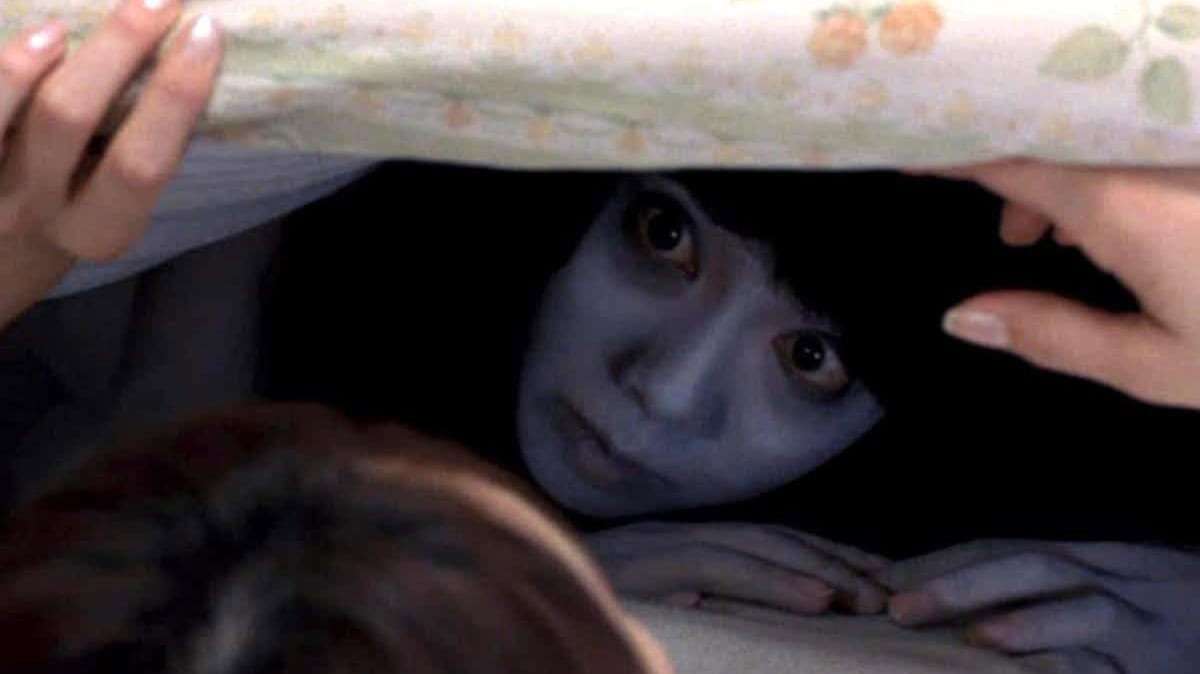
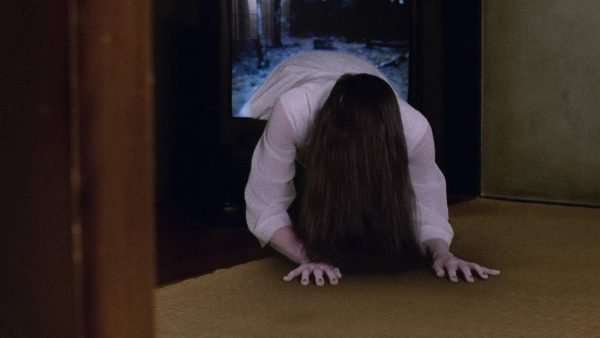
This is something crucial that Western audiences seemed to miss entirely: Sadako Yamamura, the girl in the well, the thing that crawls out of your television set in 1998’s Ringu isn’t a monster in the Western sense. She isn’t a slasher or demon. She is the consequence. She is what happens when you ignore or dismiss something. When you throw it down a well and convince yourself you solved the problem. She is the woman you underestimated, literalised into a force of nature which will find you in seven days, no matter your rationalisations or very reasonable objections.
Hideo Nakata clearly understood something important about dread, which is that it isn’t the monster leaping out of the cupboard. It’s knowing the monster is in there. It’s the seven days, and constantly checking the clock. It’s the way our protagonist Reiko Asakawa, a journalist who is also a single mother trying to navigate a society not particularly designed to accommodate her, discovers the tape and can’t stop watching. Because that’s exactly what we do. We watch. We know we shouldn’t, and we watch anyway.
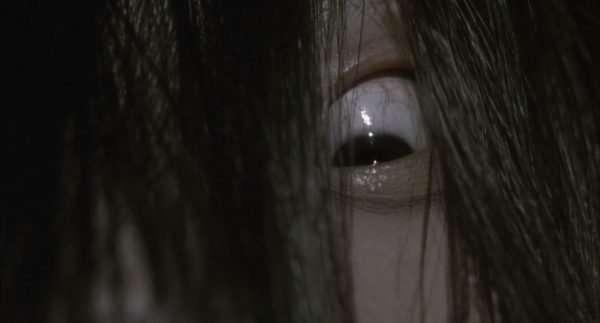
What made Ringu and its spiritual sibling Ju-On: The Grudge, directed by Takashi Shimizu in 2002, so immediately and viscerally effective is how they worked in a particular aesthetic. Let’s call it the texture of wrong.
Everything in these movies looks a little off in a way that is hard to articulate, but impossible to ignore. The light is too flat or dim, always. The angles are just slightly askew. Movement happens when it shouldn’t, in reflections, or in the background of a shot we’re not supposed to be examining too closely. The sound design is working on a frequency below conscious attention, a subsonic hum that your body registers before your brain catches up.
Shimizu in particular knew that non-linear storytelling could be a horror device itself. Ju-On doesn’t unfold; it builds up. We get presented with vignettes, fragments of encounters with the curse, in no particular chronological order, and let your mind do the assembling. This effect is incredibly disorienting. You aren’t being walked through a haunted house, you’re already in one and have lost track of which direction is out.
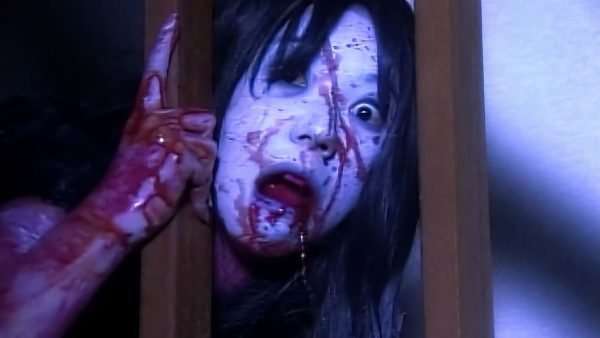
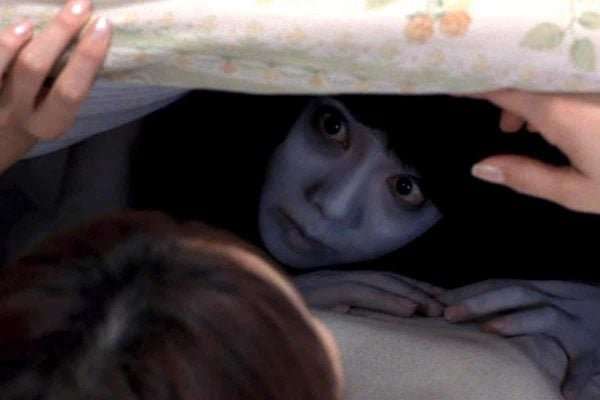
The antagonist of Ju-On, Kayako Saeki, is maybe the more nakedly political of the two great J-Horror ghosts. A woman murdered by her husband, strangled and disposed of, in a house where her young son was also killed. The curse she becomes doesn’t discriminate. There are no countdowns or bargains. You don’t even need to have wronged her specifically. The house and the energy are wrong. And if you enter, if you touch it, you’re already marked. The curse will spread like the knowledge of something terrible, and that’s its own deliberate metaphor.
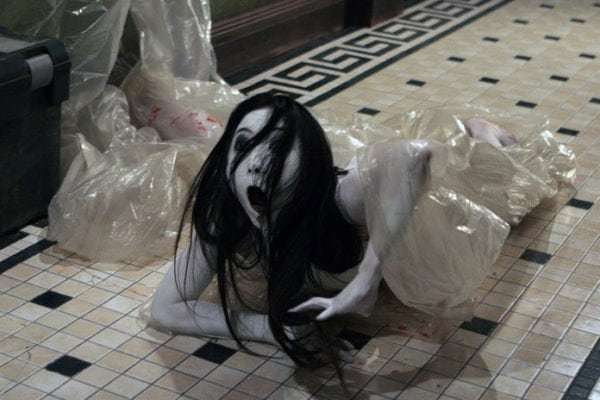
Shimizu gave Kayako a sound, a croaking, deep-throated death rattle, that sets up home in the brain stem and won’t leave. She has movements that the human body is not supposed to make. The famous cat-walk scene, with her crawling down a staircase, remains honestly physically disturbing more than twenty years later. This wasn’t CGI magic, but a performer named Takako Fuji, twisting herself into something that made our skin crawl not because it was impossible, but because it was almost possible. It occupied that exact uncanny valley where your nervous system is registering a threat before your intellect catches up.
That gap between registration and comprehension is where J-Horror lived. And it’s a gap that Western horror, used to jump scares and gore and the cathartic defeat of the monster, had largely forgotten existed. And so, it was inevitable. Of course it was inevitable.
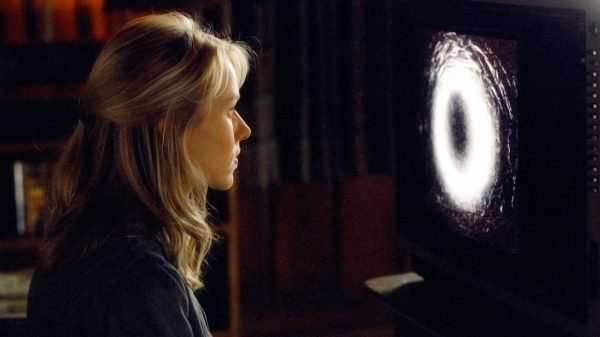
The Ring, Gore Verbinski’s 2002 American remake arrived like that very confident tourist who has done just enough research to be annoying. And the complicated thing about it is, it’s not a bad movie. Naomi Watts is really committed. There is handsome production design. The grey skies and Douglas firs of the Pacific Northwest setting do real work. Verbinski knew that you couldn’t just transplant the story to sunny suburban Ohio and expect it to work.
But something was laundered in translation. Something important.
At its cold, beating heart, Ringu is a movie about a single mother doing her job in a society which has structured itself in a way to make her job impossible. Yes, Reiko Asakawa investigates the tape because she’s a journalist, but also because someone has to and she is someone who has made it a habit of being the person who does the necessary thing when nobody else will step up. Her ex-husband Ryūji is brilliant but useless, in that specifically angering way of brilliant but useless men. The horror here is more than supernatural, it’s also structural.
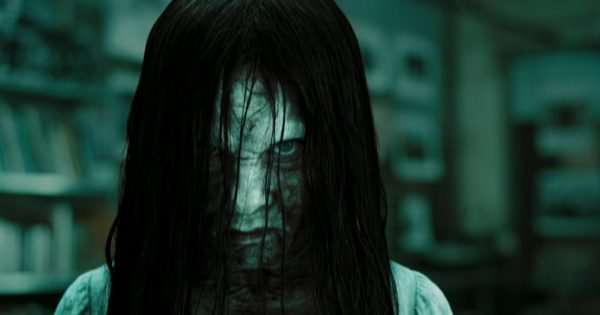
In The Ring, Rachel Keller is also an overworked single mother, and Watts plays her with real exhaustion. But the American movie is, at the end, less interested in her as a social phenomenon than as a protagonist. She becomes just a woman in danger, and not a woman navigating danger in a system which was already antagonistic to her very existence. The critique, such as it was, ended up smoothed out. It was made universal, and a little generic.
And then we have Samara.
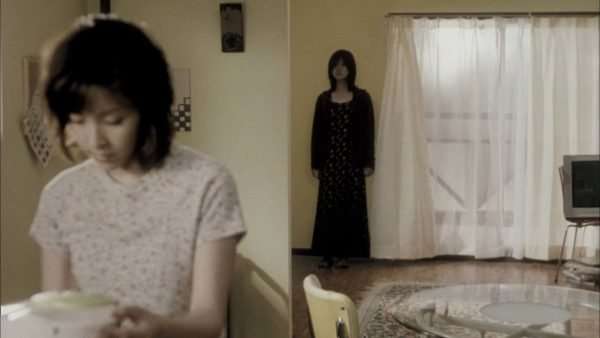
Sadako is pale, with dark hair, wearing a white burial kimono and moving in ways that imply her relationship with physics was discarded long ago. She is deeply and specifically Japanese, rooted in the onryō tradition of wronged women haunting the living, with a visual vocabulary stretching back centuries. When she crawls out of that television set in Ringu, something in our hindbrains recognises an archetype, even if we can’t name it.
Samara is…well. Samara is a child with a tragic backstory and who was also possibly evil from birth, with her supernatural capacity coming from an ambiguous well of innate malevolence instead of posthumous fury. This is a fundamentally different, and if we’re honest, fundamentally less interesting, scenario. The American movie reaches for the explanation. It wants to know why, and provides a why. Ringu understands that the why is knowable and also beside the point. What matters is the seven days, and the sound when the tape ends.
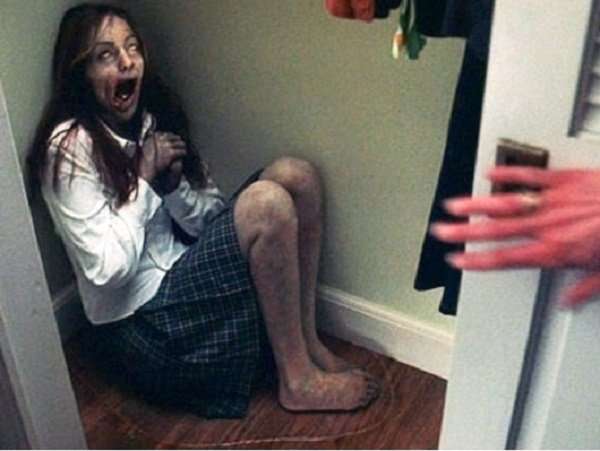
The American Ring was hugely successful. It commercially validated everything about the formula of the remake. It also launched a decade-long strip-mining of J-Horror that produced diminishing returns with all the efficiency of a factory farm.
After The Ring, the machine was switched on.
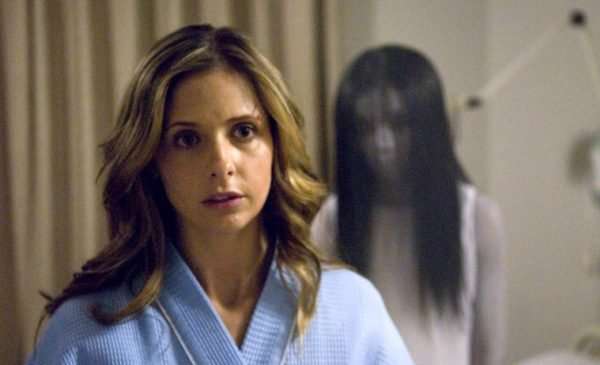
The Grudge came along in 2004, directed by Shimizu himself, imported perhaps to provide authenticity, or perhaps the studio wanted a product that couldn’t be dismissed as simple imitation. It’s an interesting case study in the limits of self-translation, as Shimizu understood his own material. He rebuilt the non-linear structure, kept Kayako and her sounds and movements and transplanted the whole story to Sarah Michelle Geller. Doing her best, which to be fair, is genuinely decent.
But the production context moved what the movie could mean. The curse in Ju-On spreads because the connection spreads. And it’s because to know is to be implicated. Grief, guilt, and the consequences of domestic violence aren’t contained by walls. In the American version, which was watched by an audience with less cultural fluency in the very specific tradition Shimizu was invoking, Kayako risks becoming just a very creepy monster. The domestic violence backstory is there, but it sits in the movie like an exhibit instead of a thesis.
After that came Dark Water, One Missed Call, Pulse, Shutter, a conveyor belt of remakes, all demonstrating less understanding of the source material than the one that came before it, and each one smoothed down a little more for an audience that seemed more and more impatient with ambiguity. The Hollywood machine had found a new vending machine, and it was hammering on those buttons.
But what the machine didn’t really want to examine was just why the originals worked. Because the answer to that was inconvenient. The answer was that they worked because they came from a specific cultural anxiety and a specific folklore tradition. There was a precise visual grammar and political anger. You can’t separate the aesthetics of J-Horror from the gender politics of the genre. You can’t pull out the slow burn and sell it without the foundation of female rage on which it grows.
And that is something American studios did not want to think too hard about, because those studios in 2002 were not really in the business of thinking hard about anything. And at its heart, J-horror is a cinema of female rage.
The tradition of the onryō is ancient. The wronged woman, betrayed and murdered, returning in death to do what she couldn’t in life is a fixture of Japanese cultural imagination going back at least to the Heian period beginning in 794. She isn’t sympathetic in the conventional sense, and she is not interested in your sympathy. She is interested in your suffering, and she has earned the right to pursue it through the depth of her own.
Sadako was an illegitimate child with psychic gifts. She was murdered for being inconvenient. Kayako was a wife whose obsession and love were met with violence. Both of them died because someone in a position of power, specifically patriarchal power, considered them a problem and chose the oldest and most permanent solution to problems that societies have traditionally applied to inconvenient women.
Their horror isn’t random. Their horror is targeted with the precision of built-up grievance.
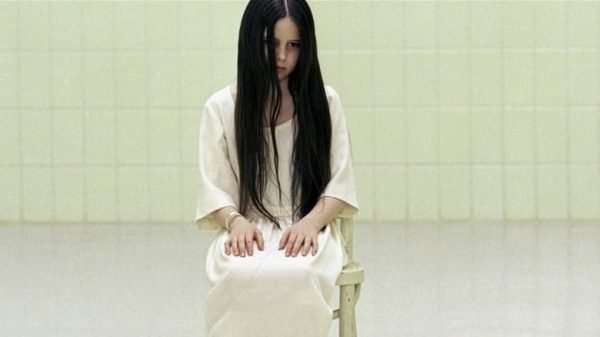
The Western remakes largely flinched away from this reading. It’s not that the backstories were erased; they weren’t, not completely, but they were contextualised differently. Samara’s evil is partly innate. The horror in The Ring tilts towards the child as the monster rather than society as the monster. And that shift is comfortable. It’s a shift that lets the audience off the hook. Ringu does not let you off the hook. Ringu suggests, with the patience of someone who has been waiting a very long time, that the hook was always there. You just weren’t paying attention to it.
By temperament, I’m not a pure nostalgist. Nostalgia can be the last refuge of people who are afraid of the present, and I’ve always found the present more interesting, if more uncomfortable. So let me be fair.
The Ring introduced a huge audience to the emotional register and aesthetics of J-Horror and who would never have sought out Nakata’s original. It built a context where subtitled Japanese horror could find Western distribution, and the originals could be dug out and appreciated. For every viewer who watched The Ring and left it there, there was another who went looking, found Ringu, then Audition (1999) then Battle Royale (2000). Then moved on to Kiyoshi Kurosawa’s Cure (1997) and Pulse (2001). And then kept on pulling on that thread until they had consumed the whole extraordinary output of a decade of Japanese genre moviemaking that by any reasonable measure was doing more interesting work than its Hollywood counterpart.
In this sense, the remakes served as advertising for the source material. They may have been hugely imperfect, frequently condescending, and sometimes genuinely incoherent advertising, but advertising nonetheless.
There is also a real conversation to be had about cultural adaption as its own creative act. Shimizu remaking his own movie in English isn’t quite the same as a studio committee reverse-engineering someone else’s masterpiece. The question of what survives translation, and what should survive translation is truly interesting. More than any other genre, horror is rooted in the specific. The specific fears and textures, the specific cultural wounds of a moment and place of origin. What happens when you move it is a kind of experiment.
The experiment mostly failed. But even the failure is instructive.
The lesson which Hollywood didn’t learn, and continues not learning with all the persistence of someone taking the same wrong turn repeatedly while refusing to look at the map, is this: you cannot separate the surface from the substance.
The long-haired ghost girl crawling out of the TV isn’t frightening because she has long hair and moves weirdly. She’s frightening because she represents something. She is the embodiment of a historically grounded, exact, and culturally resonant form of female rage. She is the consequence of your dismissal, and the patience of the discarded. Yes, you can copy the image, but you can’t copy the meaning without understanding it first. And understanding the meaning requires us to engage with the discomfort it produces.
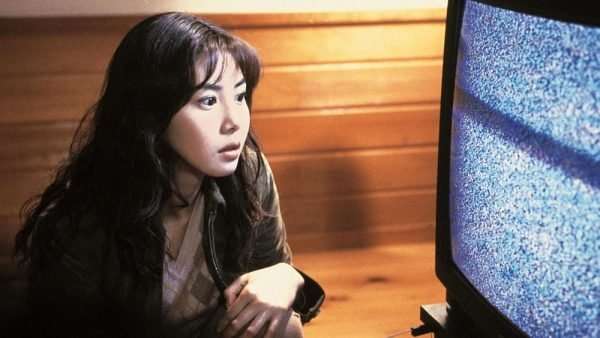
At its commercial mainstream, American horror traditionally has preferred monsters you can kill. Preferably, monsters whose defeat provides a catharsis. Even better, monsters with origins that can be explained and whose threat can be resolved by the third act. At its best, J-Horror offers none of these consolations. In Ringu, the curse isn’t defeated, it’s spread. The solution Reiko finds isn’t a cure, it’s a proliferation strategy. She doesn’t neatly save herself; she saves herself by making herself complicit in the continuance of the curse.
That is a truly bleak ending. It’s also a truly intelligent ending. Because it says something honest about the way certain types of damage, damage done to women by violence or the damage done to societies by systems they refuse to examine, don’t get resolved. They get transferred or managed, not solved. They ripple outwards through time, touching everyone eventually.
This isn’t a comfortable thing to say in a summer blockbuster. And so it wasn’t said.
So, for a final thought, go watch Ringu. Then watch Audition. And watch Cure. Then watch Shimizu’s original Ju-On short movies; low-budget and grainy, shot on video and all the more frightening for it. Watch these movies in the dark, sound up and subtitles on, and at an hour when your defences are down and your nervous system is honest.
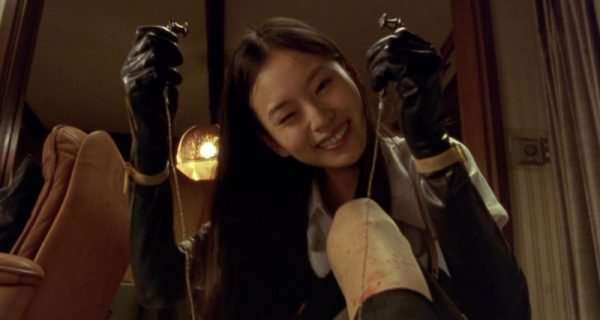
Then, if you like, check out the remakes. They honestly aren’t without value. They’re evidence of something, of what a culture reaches for and can’t quite grasp, the gap between appropriation and understanding, and how even failed translations can highlight the original by negative space.
But don’t let the remakes be the thing. Don’t let the explained, cleaned-up and catharsis-providing Americanised version of the fear be a stand-in for the real fear, which is stranger and older and far more patient than anything Hollywood was willing to produce.
The well is still there, and Sadako is still at the bottom of it. She has been there a very long time.
And she is not in a hurry.
Adam Page