This article first appeared in Radio Times magazine.

“Thirty years of hurt” is a lyric in a song I co-wrote in 1996 – specifically, a line that came out of my, and Frank Skinner’s, realisation that the word “pain” wasn’t going to rhyme with the word “shirt”. Now, in a blink of an eye, those years have doubled in number and I’ve made a radio series/podcast called – come on, you can work this out – Sixty Years of Hurt.
It’s about England and football, obviously, but more, England through football. What football reveals about England: its hopes, delusions, anxieties, mythologies, occasional moments of grace, and constant underlying sense that something has gone wrong.
Because, as regards national identity and football, like the Facebook box people used to tick next to Relationship Status, it’s complicated.
Let’s – as they say on social media – say the quiet bit out loud. English people feel, with this game, that essentially: it’s our ball. Football is ours. We codified it. We gave it to the world. We won one big victory in 1966, which has sat on our consciousness ever since, somewhere between an heirloom, a comforter and a curse.
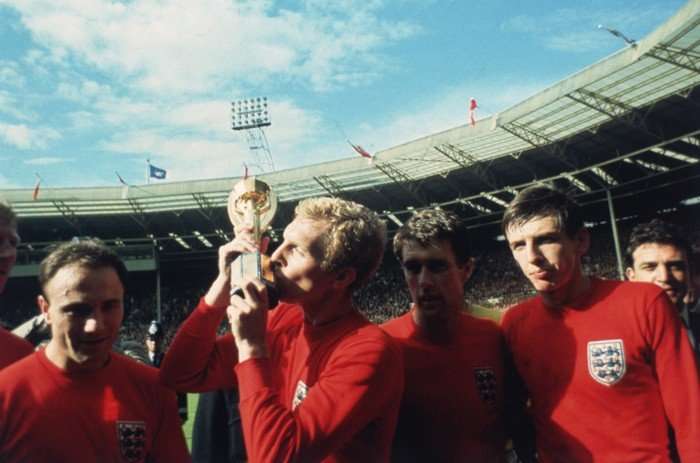
But then, frustratingly, the world started playing it better. Which produces a very English mix of entitlement and insecurity. We expect to be restored to our rightful home, one that contains many trophies, while knowing absolutely that said home is a fiction.
Somewhere inside is an imagination of an Arthurian idyll of England, where we always win, while hardly even trying. And then, at some level we feel that the results that don’t bring us to that place are just wrong.
Wales, Scotland and Northern Ireland don’t labour under the same mythology of expectation. Welsh and Scottish fans, in fact, seem to have a general advantage over England, because their national identities are at least partly rooted in, um, not being England.
Which is why Scotland fans – as now, despite their own 28 Years of Hurt – arrive in tournaments intent on having a good time, rather than going out frustrated, disappointed and smashing up bars.

I don’t know how much football truly reflects national identity, but it’s hard not to see some aspects of it as endemic to Englishness itself.
In episode two, I look at how often England managers have turned against various maverick genius players, from Rodney Marsh to Matthew Le Tissier, and wonder if this represents two opposite poles of Englishness: one ordered, controlled, authoritarian; the other anarchic, shambolic and mainly interested in having a laugh.
Other countries aren’t so split. In Argentina, as sportswriter Jonathan Wilson explains to me, their national origin figure is the gaúcho, a cowboy from the Pampas; but later, in the cities, that transformed into the pibe, an impudent kid, full of street smarts and tricks, always outwitting the authorities. And then, weirdly, that myth is embodied by someone called Diego Maradona.
In England, the player who might eternally embody Englishness is less clear. For a long time, with his combination of humility, grace, skill and combover at 23, it was Bobby Charlton.
But by the 90s, the most famous England footballer wore a sarong, exuded sex appeal and earned more money than Charlton could have imagined. Which tells us, perhaps, that Englishness is more complex than some other national identities, and football only holds up a mirror to its many changes.
Want to see this content?
This page contains content provided by Google reCAPTCHA. We ask for your permission before anything is loaded, as Google reCAPTCHA may use cookies and other technologies. To view this content, choose ‘Accept and continue’ to allow Google reCAPTCHA and its required purposes.
The series ends, as all attempts to understand England and football must, by asking whether things might one day be different. Under Gareth Southgate, they kind of were. Not perfect, not completed, not redeemed – but different. England found a way of carrying their history without being entirely crushed by it.
We didn’t win anything, of course, but the final episode, looking forward to this World Cup, is about hope, perhaps for once without the dance with despair.
Although if there is one lesson being English teaches you, it’s to look forward to when you’re 64.
Sixty Years of Hurt is on Saturdays at 10am on Radio 4 and is available on BBC Sounds.
The latest issue of Radio Times is out on Tuesday – subscribe here.

Check out more of our Sport coverage or visit our TV Guide and Streaming Guide to find out what’s on. For more TV recommendations and reviews, listen to The Radio Times Podcast.