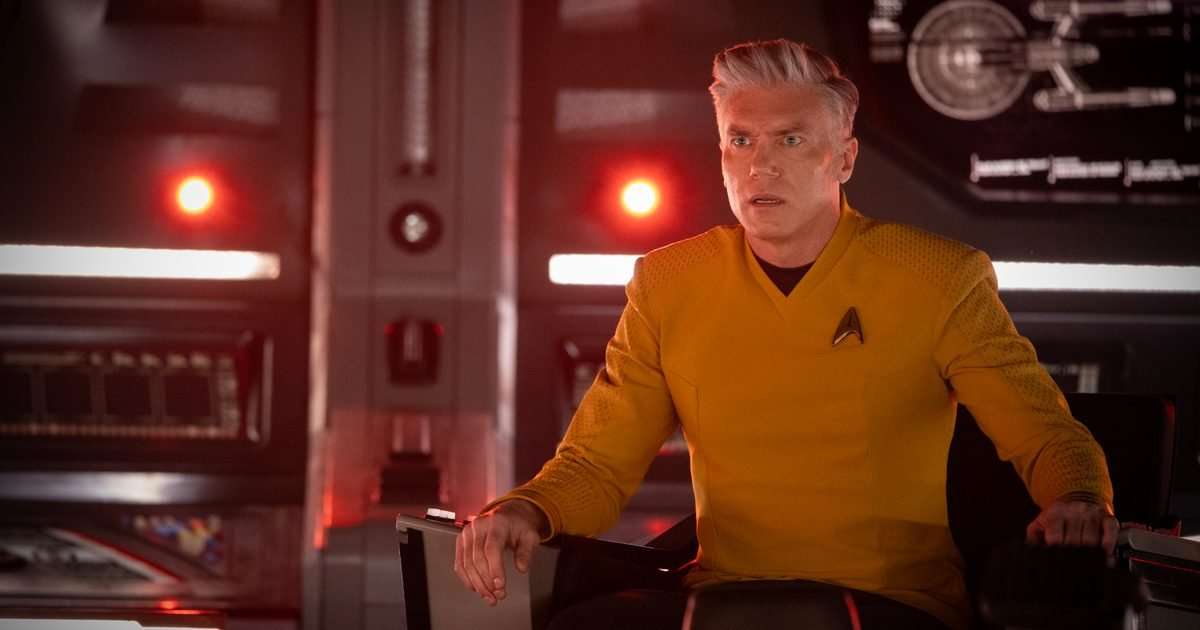
It’s not unusual for the crew of the Enterprise to boldly go where no man has gone before.

And it’s not just Strange New Worlds they venture to either. Star Trek is no stranger to time travel stories, but the season four premiere of the spin-off might just be the franchise’s boldest swing yet in this regard.
Upon encountering a planet inhabited by rather familiar-looking dinosaurs, Christopher Pike (Anson Mount) and his team realise that they’ve actually travelled back 65 million years to the planet Earth.
But it’s not long before an advanced alien race from Mars suddenly appears. Humanoid in appearance, they explain that their home world is being ravaged by arachnid creatures that threaten their world’s existence.
Later, the martians steal an antimatter fuel cell that they will use to kill the arachnids. The Enterprise plans to intervene, stopping the extinction of an entire race, but Pike backs down at the last minute and lets everything unfold as it was supposed to.
By doing so, the resulting blast sends an asteroid hurtling to earth where it kills all the dinosaurs. The remaining debris becomes the asteroid belt and Mars moves a fraction further from the sun, cooling it down to the point where life can no longer be sustained on the planet.
Yep, the Enterprise inadvertently killed off all the dinosaurs, and in doing so, paved the way for humanity to rise on Earth. So that means Star Trek is basically responsible for the origin of man. But how did humans come into being if the Enterprise, manned by many humans, hadn’t shown up in the first place?
It’s the kind of time paradox that could give you a headache, a game-changing moment that recontextualises every single thing that has ever happened (and ever will happen) on Star Trek.
“It’s definitely a big swing,” laughs Celia Rose Gooding (who plays Nyota Uhura). “We put a lot of mustard on that, yeah.”
“In the final moments of that episode, we’re all in the ready room and we see our characters trying to make sense of the time math required to understand, ‘Oh, the reason why we didn’t do this is because we never did, and we are responsible for our own…'”
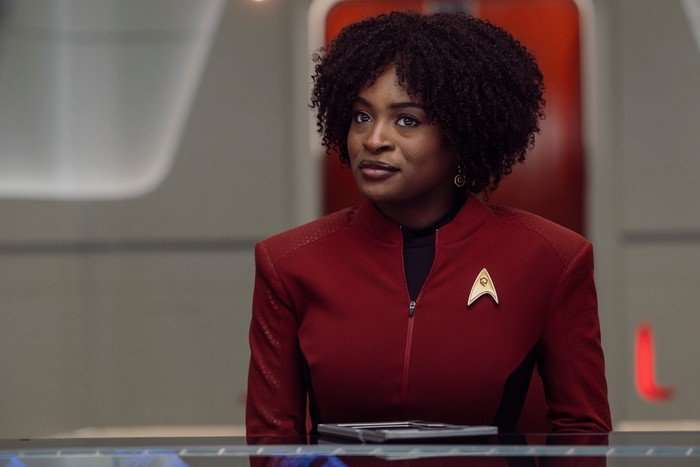
“We’re always doing that on set by the way,” chimes in co-star Anson Mount. “There’s always a moment where we have to stop the cameras and go, ‘Wait a second…’ Because there’s so many different rules that you could play with or take away from time travel. There comes a moment where you have to get on the same page with the writers, and so we are actually doing that all the time.”
“It plays really well because it’s our reality,” says Rebecca Romijn who plays Pike’s Number One, Una Chin-Riley, on the show. “There’s a certain amount of processing, mental processing that is happening in real time, and you’re seeing it.”
It’s good to know we’re not the only ones struggling to grapple with the enormity of this twist. And even more importantly, this isn’t just a one-and-done moment either.
“There’s a callback to it later in the season,” adds Romijn, “which we can’t get into now. But it does come up later. It does serve something later on.”
So it turns out that changing the history of this franchise and the universe at large will indeed have ramifications beyond the season four premiere.
But without quantum entanglement to fling us back and forth through time, fans won’t know how this plays out exactly until later this season when all that time meddling finally catches up to the USS Enterprise.
Star Trek: Strange New Worlds is available to stream on Paramount Plus. Sign up to your seven-day Paramount Plus free trial.
Add Star Trek: Strange New Worlds to your watchlist on the Radio Times: What to Watch app – download now for daily TV recommendations, features and more.
Check out more of our Sci-fi coverage or visit our TV Guide and Streaming Guide to find out what’s on. For more TV recommendations and reviews, listen to The Radio Times Podcast.