Adam Page on why David Cronenberg’s 80s body horror movies are more relevant than ever…
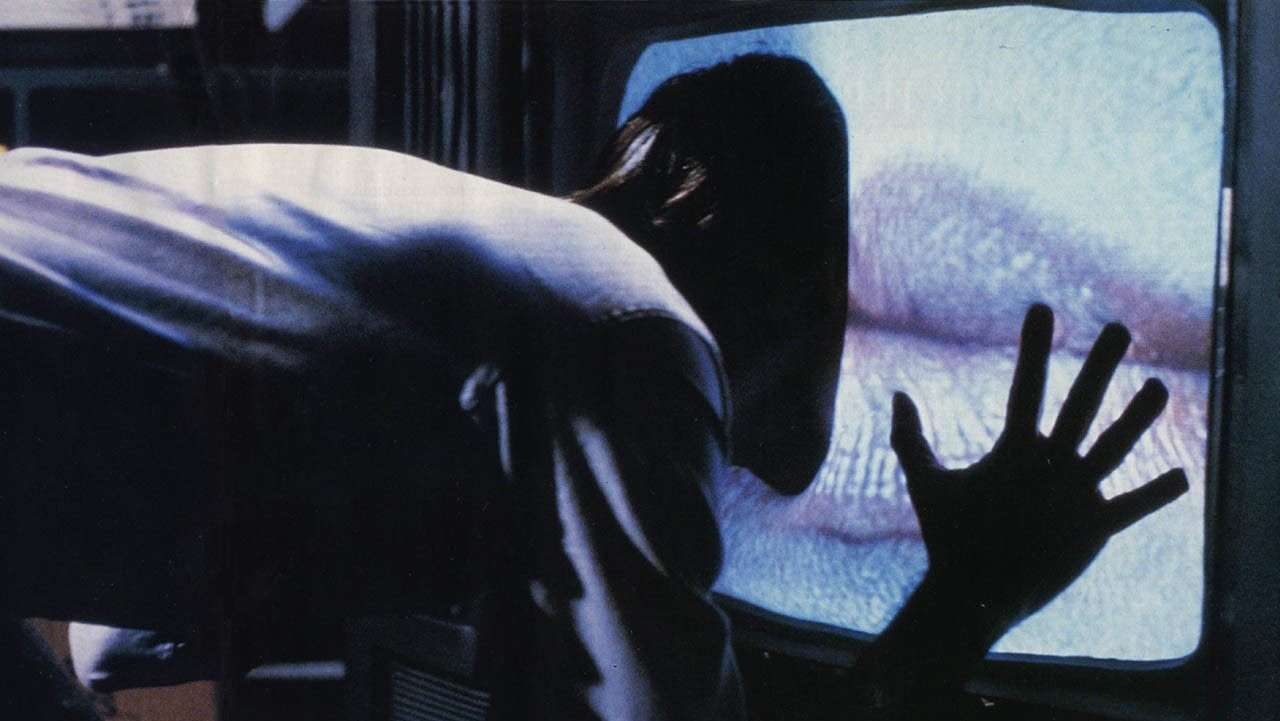
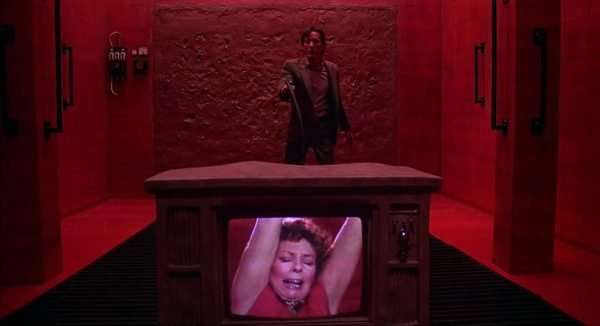
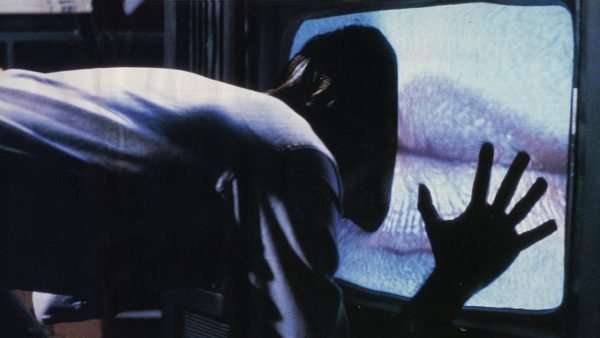
There is a famous scene in Videodrome (1983) where James Woods reaches into his own stomach. Not through it, into it. His torso has opened up, quietly and without drama like a VHS slot, and he slips his hand inside and pulls out a gun. The gun has been living there and is warm. He barely seems surprised.
David Cronenberg made this movie in 1983. At that time, he was a Canadian director with a decent cult following and a reputation for making people want to leave the cinema. He was called the “Baron of Blood” by some critics. It was meant as an insult by some of them, but they were wrong. Videodrome isn’t a horror movie. Or, it isn’t just a horror movie. It’s a philosophical treatise that also happens to contain stomach vaginas and pulsating broadcast equipment. It’s what you get when you drop William S. Burroughs and Marshall McLuhan into a blender. A smoothie we can still taste today; unsettling and terrifyingly familiar.
We have spent the past decade handing our nervous systems over to screens. We have watched as our bodies have become optimisation projects, our identities become feeds and our attention is sliced and sold by the millisecond. We’ve argued, at long length, about whether or not social media is rewriting our brains, whether our phones make us anxious, and whether the algorithm knows us better than we know ourselves. And all that time, a Canadian moviemaker was sitting quietly saying: Long live the new flesh.
Cronenberg’s great 80s run, lets call it 1981 to 1991, was bookended with Scanners and Naked Lunch, with Videodrome, The Dead Zone, The Fly and Dead Ringers in between. It’s one of the most unnerving and coherent bodies of work in cinema history. Each movie is technically its own thing: with different stars, different budgets, and different tones. But they all ask the same question, over and over, with very visceral terms. And that is: What happens to a self when the container begins to change?
The critics of the time considered these movies genre entertainment for those with an adventurously sick stomach. In his review of Videodrome, Roger Ebert called it “one of the least entertaining movies ever made” and awarded it 2 and a half stars. That’s like giving Kafka’s The Trial 2 and a half stars because the bureaucracy subplot doesn’t have a clean resolution. You’re missing the point, and the point is watching you from inside the television.
What Cronenberg was doing through those years was something that didn’t have a proper critical vocabulary yet. He was making movies about technological anxiety before the technology had even arrived. He was dramatising the dissolution of the self in a media saturated age back when most people still watched 3 channels and went to bed at 10pm. He was asking what the body meant when it becomes a site of external intervention, whether it was chemical, viral, or mechanical, and the self riding around on the inside starts to come loose from its moorings.
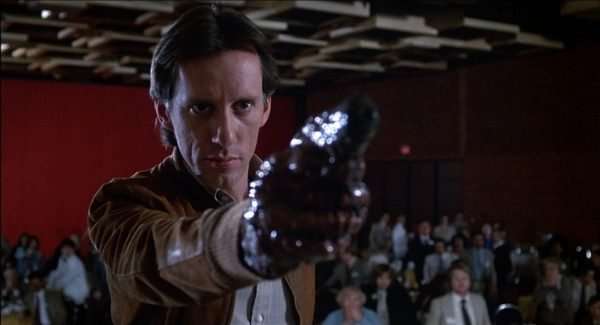
In Videodrome, Max Renn runs a UHF cable channel. In modern terms, he’s a content aggregator, finding transgressive material and piping it to an audience which has already consumed everything else. He’s addicted to signal. In other words, he is us. At least, the version of us that works in media, or that version doom-scrolling after midnight in the hope that something out there might actually make us feel something.
When Max discovers Videodrome, a broadcast signal which causes hallucinations, tumors, and a slow erasing of that distinction between what’s real and isn’t, he doesn’t run. Instead, he leans in. This is the movie’s central and most savage joke. The same thing that’s destroying him is also the most interesting thing that’s ever happened to him. Sound familiar? Because we’ve been doing this from about 2007.
Cronenberg’s genius approach is that he doesn’t moralise. Max isn’t punished for his appetite or corruption. He’s just transformed by it. The horror of the movie is not that bad men do bad things with bad technology, it’s that the technology and the man are becoming indistinct from each other. The television set is breathing and the videotape is flesh. Max’s hand changes into a gun. McLuhan told us that the medium is the message. Cronenberg goes further, telling us the medium is the body. The medium is the self.
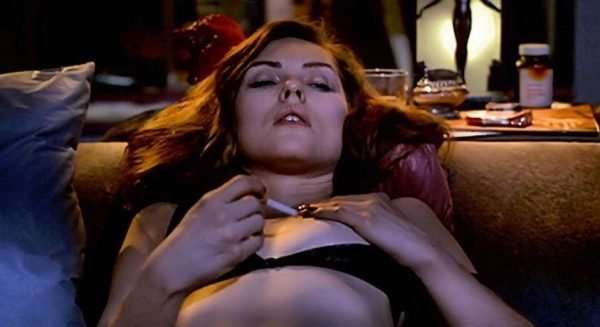
Today, we have endless debates about whether the algorithm changes us. We read studies about attention spans and dopamine loops. Thinkpieces about being “always on” are written. But we are less willing to follow that to its logical conclusion: which is that the self doing the debating has already been shaped by the same thing it’s debating. We aren’t neutral observers of our own transformation, we are Max Renn, with the hand already in the stomach and calling it research.
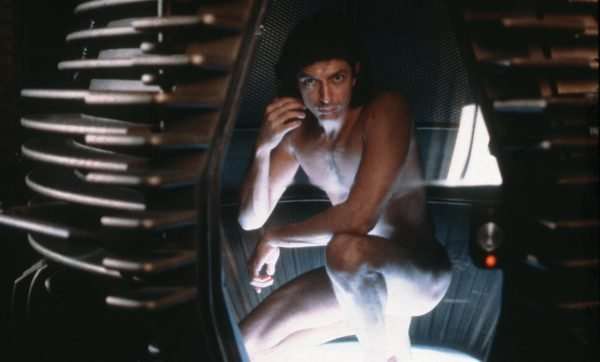
In 1986’s The Fly, Seth Brundle is a genius. He’s built a working teleportation device. At the beginning of The Fly, he is maybe the most optimistic character in any of Cronenberg’s movies; he’s warm and funny, slightly awkward in that way brilliant people sometimes are when they’ve spent far too much time alone with their machines. He believes in progress, and the idea of the body as a problem to be solved. He steps into the telepod.
SEE ALSO: David Cronenberg’s The Fly at 40: A Love Letter to the Rot
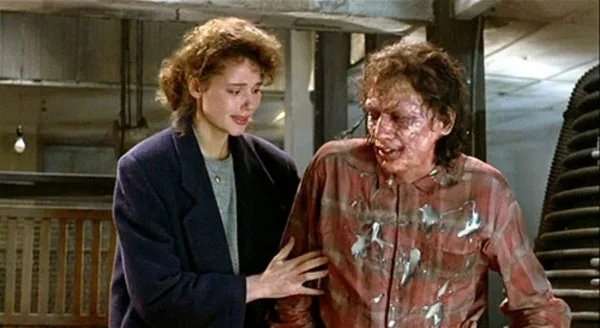
What comes next is, I think, the most formally perfect movie of Cronenberg’s career. The performance of Jeff Goldblum, how he goes through the stages of his transformation, euphoria to strength to something more insectile and alien, is one of the great pieces of acting of the decade. But the movie works not because of the horror, which is a lot, but because of the grief. Seth doesn’t become a monster, he becomes something that used to be Seth, watching itself become the monster and keeping just enough of Seth’s consciousness to realise what he’s losing.
Today’s age is one of radical self-modification. Not teleportation pods, not yet anyway, but the vocabulary is pretty similar. Biohackers plant magnets in their fingertips. Influencers are documenting their micro-dosing regimens, their peptide stacks, and ungodly cold plunges at four in the morning. Elon Musk is putting chips into human skulls. The language they use is that of optimisation: you are a system, and systems can be improved. The body is a platform. Updates available. Install now?
Brundle calls his transformation “BrundleFly” and catalogues his symptoms with scientific detachment. His lost teeth and nails are stored in a medicine cabinet, neatly arranged because he is still, after all, a scientist. Cronenberg knew that the horror of transformation isn’t the transformation itself, but the witnessing of it; that gap between the self remembering what it was and the self that is becoming something else completely. And that gap is where we all live now. In some small way, we’re all curating our own BrundleFly cabinets.
Then we come to Naked Lunch (1991). And the problem with adapting William S. Burroughs is that his work isn’t really about the things it appears to be about. At its core, the novel of Naked Lunch is not a story about drug addicts in Tangier, but about the machinery of control. And how language, ideology, habit, and desire take over a consciousness and operate it from the inside. Burroughs called language a “virus from outer space” and spent his whole career trying to slice up the infection and make the cuts visible.
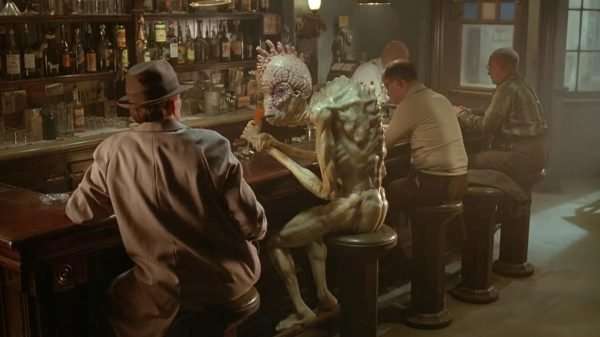
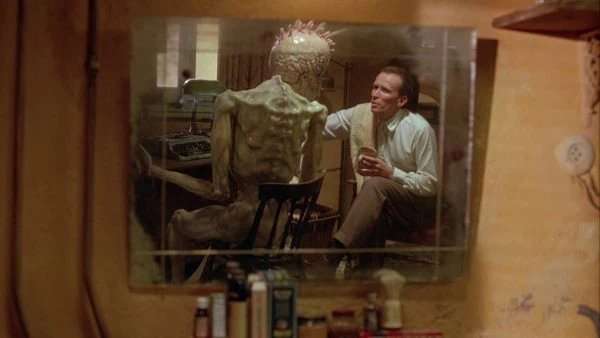
To his massive credit, Cronenberg understands this completely. His movie of Naked Lunch isn’t an adaptation of the novel; it’s a movie about the making of the novel, about just what it means to write something that comes from a place you don’t fully understand or control. William Lee is a writer who doesn’t know he’s a writer. His typewriter changes into a bug, then an orifice, and finally an oracle. It tells him things which he isn’t sure are true. He writes them anyway.
In an age of AI generated text, algorithmic content, and the collapse of that distinction between produced and produced-for-production, Cronenberg’s Naked Lunch is more interesting than ever. Who is it that’s speaking? Whose voice is that voice? The typewriter/bug doesn’t know. William Lee doesn’t know. In this vision, the creative act is not the clean expression of a genuine interior self, but a negotiation with forces that are using you just as much as you’re using them.
Interzone, the movie’s Tangier-adjacent hotbed of moral ambiguity and chemical fugue, among other things is a portrait of late-stage info capitalism. Everyone there is running a game, or several games at the same time, and no single game is more real than the others. The concept of a single, stable identity in Interzone is treated like a kind of provincial naïveté. You are what you perform, you perform what you’re paid to perform, and the only exit is through the typewriter.
So what is it that makes a body horror movie prophetic? The obvious answer is that Cronenberg was smart, and he was. Still is. But smartness by itself doesn’t produce prophecy. There were plenty of smart moviemakers who made movies in that decade that now feel dated and nostalgic. Charming in the way things from that long ago are charming. Beyond intelligence, what Cronenberg has is a willingness to take the body seriously as a philosophical object. And the ability to understand that the body is where ideology goes to become real.
Michel Foucault was working at around the same time, and making arguments very similar in academic French. He argued that the body is not a neutral container for the self. It’s the surface on which power inscribes itself. It’s categorised, disciplined, watched and finally modified by institutions with an interest in doing so. Cronenberg was making this argument in available, visceral and theatrical terms. They are movies for people who, probably rightly, don’t read Foucault, and they are all the more frightening because of it, as the argument is delivered straight through the stomach.
In Cronenberg’s movies, the body is never just a body. It’s a political space, a contested territory. Something that other people, whether they’re institutes, ideologies or technologies, want to occupy. The horror in Videodrome isn’t a stomach-vagina, it’s the fact that Max’s body has become a weapon being aimed by someone else. In The Fly, the horror isn’t all the flesh dropping off, it’s the fact that Seth’s ambition handed his body over to a process he couldn’t stop. And in Naked Lunch, the horror isn’t the hallucinating insects, it’s that William Lee’s creativity can’t be distinguished from his addiction, and both of those things are being directed by something he never clearly seen.
Look around. Our bodies are contested on every front. What we put into it, who controls what it can do, what it signals about us, how it is modified and monetised. Cronenberg saw all this coming because he was well aware that the body was the final frontier of both control and freedom. Everything else, our speech, movements, and behaviours had already been mapped. All that remained was the flesh.
Long Live the New Flesh!
That phrase, Max Renn’s delirious and terrified salute at the end of Videodrome has always been the most contested line in Cronenberg’s works. Is it surrender? Irony? Transcendence, maybe? Probably all three, in the ratio each particular viewer brings to it.
But what it isn’t, I think, is optimism. Cronenberg is clearly not a utopian. Generally speaking, his movies don’t end well. But they do end with a terrible sort of clarity; a moment when the protagonist understands, far too late to do anything about it, just what has happened to them and why. It’s clarity, but of diagnosis and not cure.
That’s really what makes these movies so uncomfortable to watch now, in these hellish 2020s. They didn’t predict everything; Cronenberg couldn’t have predicted the exact textures of today’s unease, with the particular flavour of algorithmic anxiety, and the mechanics of identity dissolution on social media. Or the still hideous way a language model completes your sentences before you’ve finished thinking them.
But he predicted the shape, that of a self under pressure from its own tools. The shape of a body that’s been handed over, little by little, to various systems it can’t fully see or understand. The shape of a consciousness that has been colonised so gradually that it experiences that colonisation as desire.
The new flesh is here. It looks like the phone we can’t put down and a recommendation engine that knows you better than your mother does and a job that needs you to act a version of you that isn’t you and a body that’s been enrolled into half a dozen different optimisation projects with none of them talking to each other. It doesn’t look like a throbbing television set, or man slowly turning into an insect. It’s subtler than that. It always is.
To his credit, Cronenberg never told us what to do about any of this. That would have been way too easy, and the man was never interested in easy. He just kept putting people into rooms with their machines and watching what happened. He kept asking the questions. And he kept not flinching at the answer.
The stomach is still open. The hand is still inside. The gun is still warm.
Adam Page