**Warning: This article contains spoilers for The Testaments book and episode 4 of its streaming adaptation. It also contains discussions of sexual abuse that some readers may find distressing.**
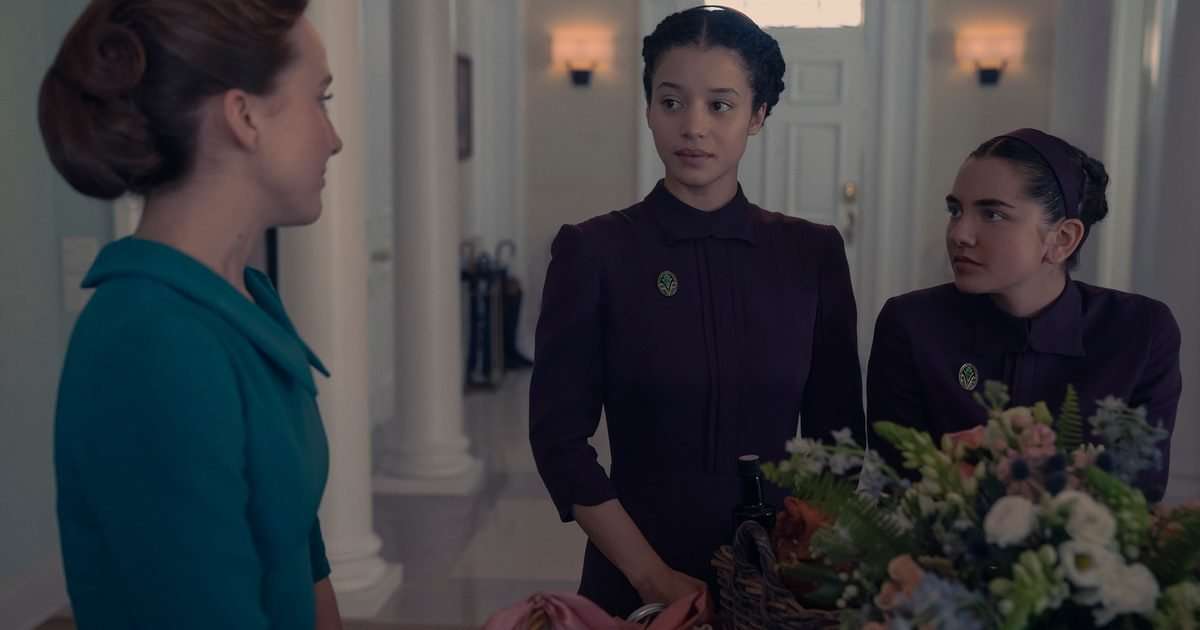
Watching The Testaments, there are moments where you almost forget just how awful Gilead really is. Almost. Everything looks so pristine, so cared for and well thought out. There’s talk of kindness and consideration and doing what’s right by your fellow man. But of course, it’s all a lie.
The fascist regime first established in The Handmaid’s Tale is a living, breathing nightmare that skews dangerously close to where we’re at in the real world these days. And it’s not just those who watch from afar that recognise this.
At the very beginning of spin-off The Testaments, Agnes MacKenzie (Chase Infiniti) is ashamed to admit that she once believed in the promise of Gilead. “It’s easier to accept a story, even a childish one, than believe the people around you are monsters.”
But there are glimpses early on of just how monstrous this society truly is.
Later in the premiere, Agnes and the other Plums are taken to see the dead bodies of those who would dare break the law in Gilead. “God’s justice is beautiful,” they say.
Further down the line, a man caught “touching himself amongst us on school grounds” is tied down as a saw slices through his body. And with an audience, no less. The girls all scream at him, shouting: “Burn in hell.” But in truth, they’re already in hell, and it’s these outlets for their suffering which help keep Agnes and the others going.
Want to see this content?
This page contains content provided by Google reCAPTCHA. We ask for your permission before anything is loaded, as Google reCAPTCHA may use cookies and other technologies. To view this content, choose ‘Accept and continue’ to allow Google reCAPTCHA and its required purposes.
Still, this is all treated as normal within the world of Gilead, and no one bats an eye. Well, no one except for Daisy (Lucy Halliday), a new Pearl who’s only just recently moved there.
We guess that’s what happens when you’re raised in a dystopian nightmare and don’t know better.
Still, it’s not long before hints at something darker below this already hellish veneer start to make themselves known to Agnes and other girls too.
In episode 2, we meet Becka’s (Mattea Conforti) father, Dr Grove, who works as a dentist in Gilead. Agnes is at his office for a check-up, and it’s all going well until Grove gets very creepy and very handsy.
“You really are getting to be a big girl, Agnes,” Grove says as he lightly strokes her breasts.
Agnes is just as shocked as she is horrified, but the moment takes her by surprise, and she’s been taught to always respect men above all else.
Nothing really comes of this until episode 4 when another appointment with Grove is scheduled. But there’s already a shift inside Agnes. As difficult as her life has been up until this point, she’s always felt safe still within the structures that Gilead provides. That’s suddenly changed now though, even if Agnes doesn’t fully understand why.
Without any prior education on sex and consent, Agnes might not fully grasp the full extent of what’s happened to her, but she knows it’s wrong.
The idea of seeing Grove again fills Agnes with dread, but go she must, because who is she to defy the adults who control her every waking moment?
Although Daisy does pick up on Agnes’s fear in the waiting room, she assumes it’s just the typical anxiety one often feels getting their teeth checked. “I guess even in Gilead no one likes to go to the f**king dentist,” Daisy thinks to herself.
Agnes needs more dental work this time around, so Grove puts her to sleep with a mild sedative. What happens next isn’t clear, not until Agnes gets home later that night.
While getting ready for bed, Agnes notices that her shirt is undone. And it wasn’t her who undid it.
The episode ends with Agnes looking horrified as she stares into the mirror and realises what Grove must have done while she slept. Although the specifics might elude her, that feeling of being violated by someone she’s supposed to trust threatens to undo Agnes entirely.
Up until this point, the horrors of Gilead have mostly been kept to the periphery, at least when it comes to the central characters. This changes everything though, bringing The Testaments more closely in line with The Handmaid’s Tale that came before it.
There, June and other handmaids were constantly abused out in the open, front and centre. This was cruelty of a permissible kind, allowed within the framework of Gilead as a nation. But the abuse that Agnes endures is more insidious, hidden behind closed doors to maintain the illusion of kindness and perfection that forms the bedrock of this society.
In the book that this show is based on – and be warned: there are big book spoilers ahead – Grove also sexually abused his daughter Becka from the age of four. Both girls refuse to report him, however, because they fear that they will be punished instead for trying to besmirch the doctor’s good name. It’s not until Aunt Lydia gets involved that justice is won in the form of Grove’s public execution.
Given the changes that have already been made from page to screen, it’s unclear at this point whether Becka is also a victim of her father’s abuse. What we do know though is that the evils of Gilead will always come to light eventually, regardless of the victim’s status.
And now we’re approaching the halfway point, it seems that The Testaments is finally peeling back the true extent of this evil. Because it’s only a matter of time before you can no longer pretend that the people around you aren’t monsters, not when wickedness lies at the foundation of this society at large.
The Testaments is available to stream on Disney+ in the UK and Hulu in the US. Sign-up to Disney+ from £5.99 a month.
Add The Testaments to your watchlist on the Radio Times: What to Watch app – download now for daily TV recommendations, features and more.
Check out more of our Drama coverage or visit our TV Guide and Streaming Guide to find out what’s on. For more TV recommendations and reviews, listen to The Radio Times Podcast.