This is…not the way. There was a time when a new Star Wars movie in theaters felt like an event. The hype in 2015 for Star Wars: The Force Awakens was through the roof. But something about a mixed reception to the sequel trilogy and several thousand Disney+ shows has given George Lucas’s once-great franchise the modern Marvel treatment. Over six years since we last visited a galaxy far, far away on the big screen, we have Star Wars: The Mandalorian and Grogu, a TV movie that finds itself coming to a theater near you.
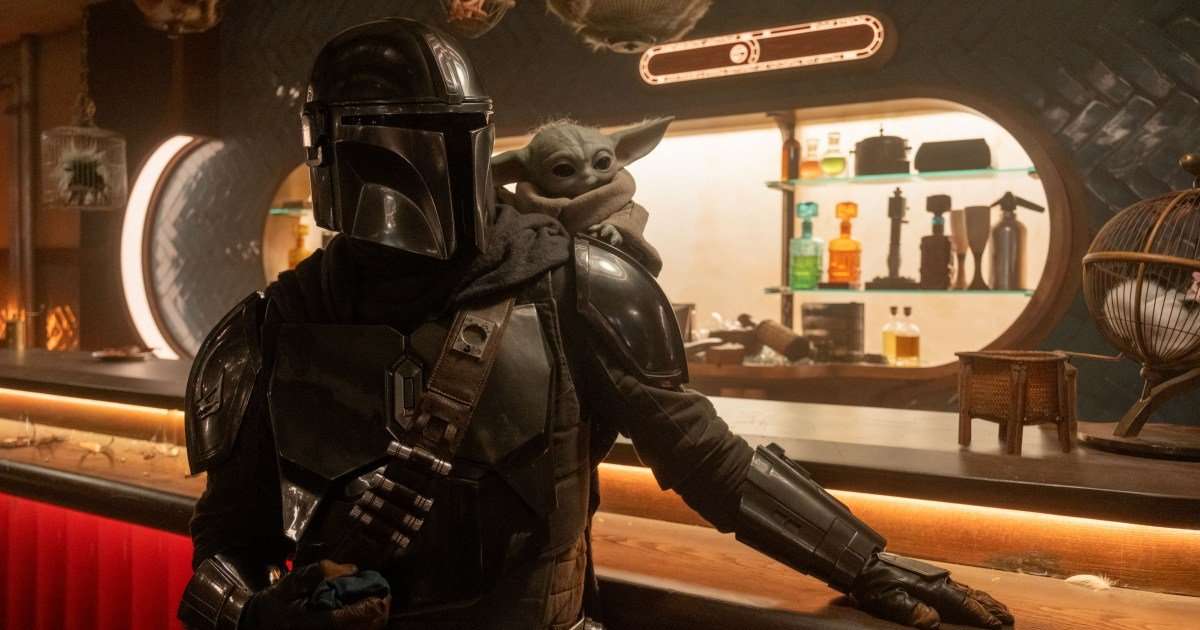
Audience excitement for this new Star Wars movie has been, well, muted. Perhaps because this movie is arriving a few years too late. We’re coming off the weakest season of The Mandalorian, and we’re now getting the weakest Disney-era Star Wars movie. The Mandalorian and Grogu is an inoffensive romp that manages to make Star Wars feel unimportant. This film is not a must-see event. This is a 2-hour-12-minute Saturday morning cartoon — a side quest that adds virtually nothing to this franchise besides a bit of fun, fleeting entertainment.
The movie opens with quite an impressive action set piece, building up anticipation for Din Djarin’s first appearance in three years. It’s fun to watch him in action. Unlike other Star Wars protagonists, like Luke, Anakin, and Rey, Din isn’t on a journey of self-discovery and growth. He’s already gone through his character development in the first two seasons of The Mandalorian, and this movie continues the flaw of season 3, which is that it reduces Din back to being a one-dimensional masked hero. Does he have a badass aura? Absolutely. Is it fun to watch him tear through Imperial warlords and Stormtroopers? For sure. But at some point, when the action is lacking in any drama, stakes, or character, it just becomes noise.
At the beginning, it is enjoyable to see a really cool character take on an onslaught of enemies. But this film has quite a significant issue with the strength of its hero and its villains. What makes many of the other Star Wars movies so exciting is that the Rebels always feel like they’re the underdogs. The antagonists, whether they’re the Galactic Empire or the First Order, always feel larger than life. Star Wars is about a group of people defying the odds and fighting like hell to overcome tyranny. You watch the Battle of Hoth in The Empire Strikes Back, and it feels like a true miracle that the Rebels were able to take down the AT-AT walkers.
But The Mandalorian and Grogu is set a few years after the end of Darth Sidious’s rule in Return of the Jedi. There is no formidable antagonist; just a few remaining Imperial loyalists. The antagonists are at their lowest. The ones that remain are no match for Din Djarin. The opening scene sees him take down three AT-AT walkers all on his own. If he alone has the strength of the entire Rebel army on Hoth, we don’t feel the tension. We don’t worry if or how he’ll come out of these situations alive because he’s far too capable from the start, and he doesn’t meet any opponents that can match his physical prowess. It’s just action for action’s sake.
After the opening sequence, we get our title card, along with some opening credits. Opening credits in a Star Wars movie?! Brief history lesson: the reason why most movies these days don’t have opening credits and instead save credits like Director, Producer, Writer, etc. for the closing credits is because of George Lucas. He popularized the trend because he wanted to preserve the dramatic opening crawl that drops you right into the story with John Williams’s music. He was even fined thousands of dollars for doing this in The Empire Strikes Back.
Cut to 2026, and we have opening credits right out of a TV show. The cinematic quality lessens here, along with the fact that this opening action scene functions very much like the “cold open” of a TV episode, as it’s a stand-alone moment that adds virtually nothing to the plot. While cold opens are customary for James Bond movies and slasher films, they feel out of place for a Star Wars movie.
It’s what happens when we have a script co-written by Dave Filoni and Noah Kloor, whose background in TV is evident here. Nevertheless, we continue, with Djarin meeting up with Colonel Ward (Sigourney Weaver). Weaver in Star Wars feels like a match made in heaven. From Alien to Galaxy Quest, she’s no stranger to space. It’s a shame that not only does Ward have zero characterization at all, but especially towards the end, this is the most phoned-in performance Weaver has given. Her line delivery is so stilted and dull, especially during a later scene where she should absolutely have a bit more energy, given the situation.
The storyline surrounds Djarin going to retrieve Rotta the Hutt (Jeremy Allen White) to return him to his family. Because the writers thought, “Hey, what story is going to get audiences into theaters? Oh, I know! Let’s continue the story of the Hutt baby named ‘Stinky’ from the 2008 animated Star Wars: The Clone Wars movie that everyone loved! That’ll get audiences out in droves!” And then Jon Favreau said, “Yes! And let’s cast Golden Globe winner Jeremy Allen White from The Bear to voice him and have him speak English! Because fans of his work in an excellent TV show will sit in theaters to hear his modulated voice come out of a giant CGI slug!” And then Disney said, “Yes! Here’s $165 million! Go to town!”
In all seriousness, this storyline surrounding the Hutts is such a strange choice. This is the first time we’re seeing Djarin in years. Shouldn’t the storyline be more personal to him? Shouldn’t it challenge him emotionally? No, of course not! The story in The Mandalorian and Grogu is one that Djarin has zero emotional investment in. He has no personal stakes in this story. It doesn’t matter to him what the outcome is. He’s just a man sent on a mission. That’s not interesting to watch. If he has no real reason to care about what’s going to happen here, why should we? What happens if he fails at his journey? Whatever happens, it would not affect Djarin in the slightest.
The film gives more emotional investment into Rotta the Hutt. Despite being the son of deceased crime lord Jabba the Hutt, Rotta is not like his father. He fights in gladiator-style tournaments and does not want to live in his dad’s shadow. A lot of his backstory is just verbally given to us. The exposition here is on-the-nose and boring. He has a line: “Do you know how hard it is to be your own man when your father is Jabba the Hutt?” I can’t say that I relate, if I’m honest. I don’t think many will be able to. Show of hands, whose father is Jabba the Hutt? Anyone? No?
It’s kind of enjoyable to watch the gladiator fights from a purely superficial standpoint. If you like taking a bunch of action figures and mashing them together, you’ll have a good time. But not everyone will appreciate these CGI-heavy fight scenes. I suppose I can’t shame the filmmakers for not outsourcing real monsters for these fights, but what I’m getting at is that the fights are so heavy in CGI that they become weightless. Star Wars has always been good at combining humans with the CGI environments and characters. It’s not interesting to watch CGI characters fight against CGI backgrounds. If this were an animated movie, that might work. But this is live-action; we’re holding this to a different standard here. There should be a practicality to these scenes that isn’t there.
What makes everything worse here is the lack of emotion. Some of that comes from the nature of this masked character. We can’t see his face, so we don’t always know when he’s panicked, frustrated, or anything. Some of that can be directed entirely through Djarin’s physicality, but we don’t see nearly enough of that. The Mandalorian and Grogu often forgets that action is character, and action is drama. It simply shows off the spectacle of big fight scenes while removing the humanity.
A core staple of the first two seasons of The Mandalorian was Djarin’s care for Grogu and wanting to keep him safe. That’s what made the season 2 finale so emotional, because Djarin needed to say goodbye to Grogu, and as an audience, we did too. But of course, Disney realized the lack of merchandising opportunities and had the two reunite in a separate, lower-quality TV show, The Book of Boba Fett. We couldn’t even go one episode of The Mandalorian without Grogu; they’re reunited by the time of the season 3 premiere, and now, we have Grogu, who’s just…there. For much of the first two acts of the movie, Grogu has nothing to do except be along for the ride and do cute things. It’s superficial; we know what they’re doing. But some just won’t care because of how cute he is.
There’s one scene where Djarin is trying to teach Grogu how to control something on the ship. It feels like the same joke we got from Guardians of the Galaxy Vol. 2 when Rocket is trying to teach Baby Groot how to do something. Speaking of this scene, it’s one of the most visually bland scenes we’ve ever gotten in Star Wars. I’m attaching the video clip below so you can watch. Whenever we’re on sandy planets, whether it be Tatooine or Jakku, there’s at least color. These are supposed to be desolate, boring locations, but this is a film, and it should be filmed as such. The lighting is completely flat, and the color grading is abysmal. Throw in some saturation! Anything!
Say what you will about the sequel trilogy, especially from a writing standpoint. You can’t deny that The Force Awakens, The Last Jedi, and The Rise of Skywalker are visually incredible. Those movies have some of the most gorgeous colors and intentional choices of any blockbuster of the past decade. People have criticized the logic of the Holdo maneuver from The Last Jedi, but nobody has said it looked ugly. Here, we have a Star Wars movie that looks like it could have been made by anyone. Favreau’s a talented director, but this is about as generic as we can get.
The bar for Star Wars feels lower than ever. There’s nothing in this movie that will spark any controversy like the Holdo maneuver or even a “Somehow…Palpatine returned.” This is safe Star Wars. This is a bunch of action scenes strung together by a thin plot. The thing with taking big creative swings is that sometimes, you miss, and the fans chastise you for years. The Mandalorian and Grogu often feels so scared to take swings that it just feels uninteresting. It doesn’t push Djarin forward in dramatic directions that are meaningful for his character. It doesn’t do anything with Grogu that we wouldn’t expect from him. This movie is mainly just Djarin in action hero mode and Grogu in cute merchandise mode.
It’s not always interesting to have a lead character so immune to vulnerability, but there are moments in the film that work. Pedro Pascal is one of the biggest actors working today, and he’s an excellent one. It should come as no surprise that he’s rarely ever actually in the suit. Once that mask goes over Djarin’s head, he is played by Brendan Wayne and Lateef Crowder, who get early billing in the credits. Wayne and Crowder do excellent jobs physically, while Pascal delivers the voiceover. He gets one unmasked action set piece where we can see he’s really doing the physical work, and it’s a highlight in the film because of Pascal’s emotions and commitment.
There are some more fun moments throughout. We have a moment where Grogu suits up to get into action like he’s Arnold Schwarzenegger in Commando or Wilford Brimley in Ewoks: The Battle for Endor. Another highlight is the Anzellans. One of the most valuable contributions that Star Wars: The Rise of Skywalker gave this franchise is Babu Frik, an Anzellan with a very particular way of speaking, and some of the funniest moments in The Mandalorian and Grogu are with the Anzellans.
This feels like a made-for-TV, direct-to-streaming movie. The most cinematic thing about this movie is the IMAX aspect ratio. Beyond that, it just feels like a long episode of the show, and not one of the better ones. The Mandalorian and Grogu lacks drama, urgency, emotional stakes, unpredictability — all necessary for a good cinematic experience. Whenever the villains are not on screen, we don’t feel their presence. This is a franchise that has iconic villains like Darth Vader, Darth Maul, Kylo Ren, and Grand Admiral Thrawn, while the villains here are two Hutts that don’t do anything! They just sit in one room for the entire film. Beyond that, we just have a conveyor belt of droids and monsters who show up whenever the movie starts to need an action scene.
There’s no excuse for the lack of characterization in this film. Djarin is boring, Grogu is boring— nothing challenges what we already know about these characters. No one is forced to make bold, unpredictable choices that come at devastating costs. They just feel like they’re on autopilot, doing what we expect. A character quite literally shows up in the final act to help out Grogu. We learn nothing about him. He shows up, and before we know it, he’s gone. He serves no other purpose. He’s not a character; he’s a plot device.
What we’re left with is a low-stakes Star Wars movie. There’s no planet-killing Death Star, no Starkiller Base, no big battles. Every other Star Wars film has at least one standout sequence. I felt more watching the Battle of Exegol in The Rise of Skywalker than I did during this film. Even other stand-alone movies like Solo: A Star Wars Story, which also didn’t concern itself with lightsabers or the Rebels, had moments like the Kessel Run set piece that really stood out. Nothing stands out here in The Mandalorian and Grogu, as it’s a generic, safe Star Wars movie.
SCORE: 5/10
As ComingSoon’sreview policyexplains, a score of 5 equates to “Mediocre.” The positives and negatives wind up negating each other, making it a wash.
Disclosure: ComingSoon attended a press screening for our The Mandalorian and Grogu review.