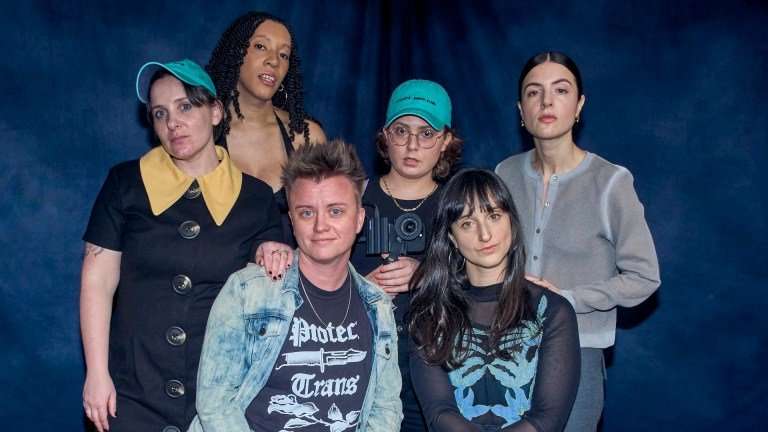
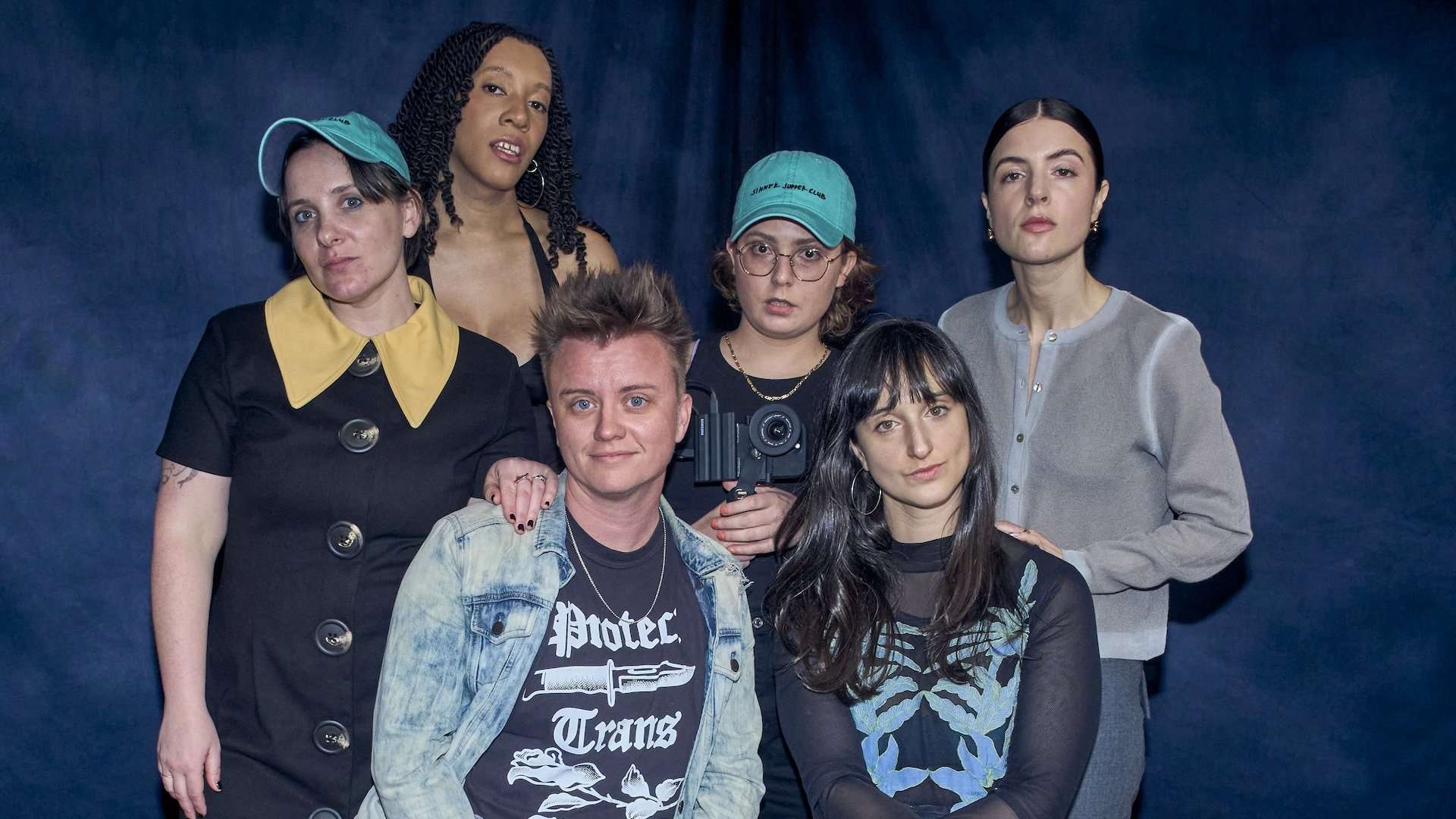
Mumblecore continues to grow into new genre offshoots. This year’s Sinner Supper Club has already been called both “mumblegore” and “mumblequeer,” but Nora Kaye and Daisy Rosato, who co-wrote and directed the movie, seem happy to embrace all the mumbles while taking things in a different direction.
“Mumblecore is a movement that kind of started here,” Kaye tells Den of Geek at SXSW in Austin, Texas. “The Puffy Chair, Baghead, Creep. It’s a movement of people who kind of said ‘fuck it’ to the studio system and brought their friends together, shot in the now with a lot of handheld [cameras], using whatever they had to make a movie. We were like, ‘Well, what if we did that, but instead of predominantly cis white men, it was our incredible community of clowns and trans and queer folks?’”
Their movie, an improvised story shot in just six days, tells the story of a turbulent queer friend group who get together for a final party before one of them moves away, priced out by NYC rent. It also just happens to be their first tense gathering since a friend died. This supernatural element has led to some labeling Sinner Supper Club as a “mumblegore” feature, but that’s only a piece of what it has to offer.
“Mumblegore is definitely an emerging subgenre of horror,” says star Sophie Sagan-Gutherz. “I think it takes mumblecore one step further. You’re watching something that you feel like you shouldn’t really be engaging with, and it emits stress and discomfort. There are moments in our film where we do lean into that genre.”
The directors were also influenced by the Dogme 95 film The Celebration, part of the movement originally founded by Lars von Trier and Thomas Vinterberg to strip back cinematic artifice, as well as by the tradition of using a more “consumer level” camera. As a result, Sinner Supper Club was filmed entirely on an iPhone.
“I think there’s a lot of resurgence and nostalgia around the mini DV cameras and camcorders that films like that [used],” explains Rosato. “The films made in 2025 or 2026 that are like that are great, but they’re not really ‘of the now’ in the same way. So we were like, ‘What would be our version of a mini DV camcorder?’ which is the iPhone. It started as a creative translation point, but it also became very accessible because I was able to submerge myself and the camera in a shower to shoot one scene. I wasn’t worried about the camera breaking, because these can be submerged under water. We threw it in a freezer, and we mounted it to a bike. It just made it a lot easier to play very quickly and keep up with our actors and ideas.”
Kaye notes that using an iPhone allowed them to get close to the actors and create a movie with “propulsion and freneticism.” They didn’t need to take breaks to set up new shots. And because people are used to having phones in their faces all the time these days, it didn’t feel strange to be improvising in front of them.
“We were given an outline every day,” star Jayae Riley Jr. reveals. “Nora and Daisy plotted out the entire script. We were given a beginning, a middle, and an end, with action beats in between. It was a lot easier to improvise off of that, because we had a ton of information about the character, about the day, about how it was going to go, about any conflicts that needed to happen.”
Co-star Elise Kibler adds, “I think the nature of the way that we made this, at least to me, made the stakes feel a little bit lower. We were surrounded by our friends. We were excited about spending the week creating something together. And because we had such minimal equipment, there was a feeling very different from being on your typical set where there’s a [lot of] people and everything takes forever. This was just fast and loose. I think it took some of the pressure off that you might feel to create the perfect scene, or the perfect lines, and I think that freedom led to a lot of the wonderful lines that my fellow actors created in our film.”
Rosato and Kaye originally met through their screenwriting work, with both finding they were drawn to complicated, “fucked up” ensembles. The pair created the characters of Sinner Supper Club before casting them, using “a base of clown” as archetypal jumping-off points.
“They gave each of us a different one of the seven deadly sins as the center of our character,” explains star Genevieve Simon. “That also really helped in the improvs. Every time there was a scenario, I was like, ‘Okay, how would my sin relate to, not only this situation, but also the other sins’ impulses?’ It allowed us to tap into maybe uglier parts of ourselves, or the parts of yourself that you show your close friends but that you wouldn’t present at work.”
As the film progresses and the pressure mounts on host Genevieve to fix the friend group’s myriad problems before leaving, they take their NYC “wake” from the overbearing heat of a sunny park into the humid apartment from where Genevieve is being evicted. The gathering quickly turns even more tense, and the arrival of their dead friend only amplifies the gang’s problems.
Sinner Supper Club explores deep themes of grief and loss from queer perspectives, which also worked for the cast and crew on a meta level. “Daisy and I have a shared dead best friend,” Sagan-Gutherz says. “A lot of us have experienced loss, so it was an honor to play a dead best friend, because I have one.”
During a standout seance scene in the film, Sagan-Gutherz delivers an incredible performance as the late friend, but Kaye notes that the scene was retooled after it wrapped the story up in too neat a bow. “We watched it with some audiences, and it wasn’t working, because this whole movie is about embracing chaos and messiness, and we were trying to make something perfect out of something that is so imperfect. Laura Conte, an incredible editor, really helped us find how to get a perspective on grief that embraces that mess and unfinishedness, because there is no finishing.”
Sinner Supper Club premiered March 12 at the SXSW Film & TV Festival.